


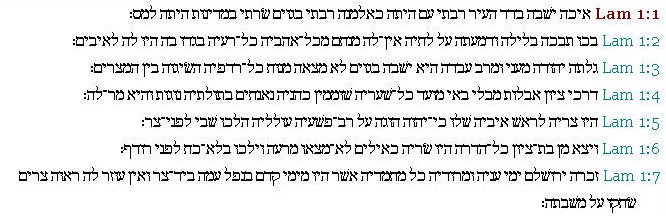
1:1 אֵיכָ֣ה׀ יָשְׁבָ֣ה בָדָ֗ד הָעִיר֙ רַבָּ֣תִי עָ֔ם הָיְתָ֖ה כְּאַלְמָנָ֑ה רַבָּ֣תִי בַגּוֹיִ֗ם שָׂרָ֙תִי֙ בַּמְּדִינ֔וֹת הָיְתָ֖ה לָמַֽס׃ ס
Eichah yashevah vadad, ha'ir rabati am, hayetah ke'almanah; rabbati vagoyim, sarati bamedinot, hayetah lamas.
How does the city sit solitary That was full of people! How is she become like a widow! she that was great among the nations! The princess among the provinces Has become a vassal (mas מס)!
1:2
 בָּכ֨וֹ תִבְכֶּ֜ה בַּלַּ֗יְלָה וְדִמְעָתָהּ֙ עַ֣ל לֶֽחֱיָ֔הּ אֵֽין־לָ֥הּ מְנַחֵ֖ם מִכָּל־אֹהֲבֶ֑יהָ כָּל־רֵעֶ֙יהָ֙ בָּ֣גְדוּ בָ֔הּ הָ֥יוּ לָ֖הּ לְאֹיְבִֽים׃ ס
Bacho tivkeh balaylah, vedim'atah al lecheyah, ein-lah menachem mikkol-'ohaveiha; kol-re'eiha bagedu vah, hayu lah le'oyevim.
She weeps bitterly in the night, Her tears are on her cheeks; Among all her lovers She has none to comfort her. All her friends have dealt treacherously with her; They have become her enemies.
1:3
 Yehudah is gone into golus (Exile) because of affliction, and
because of great servitude: she dwells among the nations, she
finds no rest: all her persecutors overtook her between the
straits.
Yehudah is gone into golus (Exile) because of affliction, and
because of great servitude: she dwells among the nations, she
finds no rest: all her persecutors overtook her between the
straits.
1:4
 The derek
(ways) of Tzyon do mourn, because none come to the solemn
moedim: all her she'arim (gates) are shamem (desolate): her kohenim sigh, her
betulot (virgins) are afflicted, and she [is] in marar (bitterness).
The derek
(ways) of Tzyon do mourn, because none come to the solemn
moedim: all her she'arim (gates) are shamem (desolate): her kohenim sigh, her
betulot (virgins) are afflicted, and she [is] in marar (bitterness).
1:5
 Her adversaries hayah
(are) the chief, her enemies prosper; for ADONAI (יהוה) has afflicted her for the multitude of her
pesha'im (transgressions): her children are halak (gone) into shabi (captivity) panim
(before) the
enemy.
Her adversaries hayah
(are) the chief, her enemies prosper; for ADONAI (יהוה) has afflicted her for the multitude of her
pesha'im (transgressions): her children are halak (gone) into shabi (captivity) panim
(before) the
enemy.
1:6
 Ve
ye tze (and from) the bat Tzyon all her beauty is departed:
her sarim (princes) are become like stag [that] find no pasture, and
they are halak without strength before the pursuer.
Ve
ye tze (and from) the bat Tzyon all her beauty is departed:
her sarim (princes) are become like stag [that] find no pasture, and
they are halak without strength before the pursuer.
1:7
 Yerushalayim (ירוּשׁלם) zakar
(remembered) in the yamin Oni (days of affliction) and of
her miseries all her pleasant things that she had in the mimei kedem
(days of old), when her people fell into the hand of the enemy, and
none did help her: the adversaries saw her, [and] did mock at
her mishbat (ruin משׁבּת).
Yerushalayim (ירוּשׁלם) zakar
(remembered) in the yamin Oni (days of affliction) and of
her miseries all her pleasant things that she had in the mimei kedem
(days of old), when her people fell into the hand of the enemy, and
none did help her: the adversaries saw her, [and] did mock at
her mishbat (ruin משׁבּת).
1:8
 Yerushalayim has grievously chata
(sinned); therefore she is nidah (uncleaned):
all that honoured her despise her, because they have seen her
ervah (nakedness, expose): yea, she sigheth, and turns backward.
Yerushalayim has grievously chata
(sinned); therefore she is nidah (uncleaned):
all that honoured her despise her, because they have seen her
ervah (nakedness, expose): yea, she sigheth, and turns backward.
1:9
 Her tumah (filthiness)[is] in her skirts; she remembereth not her
last end; therefore she came down wonderfully: she had no
Menachem (comforter). O ADONAI (יהוה), raah (see) my oni: for the enemy has
magnified [himself].
Her tumah (filthiness)[is] in her skirts; she remembereth not her
last end; therefore she came down wonderfully: she had no
Menachem (comforter). O ADONAI (יהוה), raah (see) my oni: for the enemy has
magnified [himself].
1:10
 The adversary has spread out his yad
(hand) upon all her
pleasant things: for she has seen [that] the nations entered
into her mikdash, whom you didst command [that] they should
not enter into your kahal (assembly).
The adversary has spread out his yad
(hand) upon all her
pleasant things: for she has seen [that] the nations entered
into her mikdash, whom you didst command [that] they should
not enter into your kahal (assembly).
1:11
 All
(kol) her people sigh, they seek lechem; they have given their
pleasant things for okel (food) to relieve the nefesh: see, O ADONAI (יהוה), and
consider; for(ki)
I am become zalal (despised ).
All
(kol) her people sigh, they seek lechem; they have given their
pleasant things for okel (food) to relieve the nefesh: see, O ADONAI (יהוה), and
consider; for(ki)
I am become zalal (despised ).
1:12 [Is it] nothing (lo) to you, all ye that pass by? nabat (look), and
raah (see) if there be any sorrow like to my sorrow, which is done
to me, wherewith ADONAI (יהוה) has afflicted [me] in the day of
his fierce anger.
[Is it] nothing (lo) to you, all ye that pass by? nabat (look), and
raah (see) if there be any sorrow like to my sorrow, which is done
to me, wherewith ADONAI (יהוה) has afflicted [me] in the day of
his fierce anger.
1:13
 From above
(mi
marom) has he sent fire into my etsem
(bones), and it
prevaileth against them: he has spread a net for my feet, he
has turned me back: he has nathan (made) me shamem (desolate) [and] faint all
the day.
From above
(mi
marom) has he sent fire into my etsem
(bones), and it
prevaileth against them: he has spread a net for my feet, he
has turned me back: he has nathan (made) me shamem (desolate) [and] faint all
the day.
1:14
 The yoke (עול) of my pesha'im
(transgressions) is bound by his hand: they
are wreathed, [and] come up upon my tzavar (neck): he has made my
strength to fall, *ADONAI (יהוה) has nathan
(delivered) me into [their]
hands, [from whom] I am not able to rise up.
The yoke (עול) of my pesha'im
(transgressions) is bound by his hand: they
are wreathed, [and] come up upon my tzavar (neck): he has made my
strength to fall, *ADONAI (יהוה) has nathan
(delivered) me into [their]
hands, [from whom] I am not able to rise up.
1:15 *ADONAI (יהוה) has salah (rejected) all my strong [men] in the
midst of me: he has called an assembly against me to crush my
young men: *ADONAI (יהוה) has darak (trodden) betulah, bat
Yehudah, [as] in a winepress.
*ADONAI (יהוה) has salah (rejected) all my strong [men] in the
midst of me: he has called an assembly against me to crush my
young men: *ADONAI (יהוה) has darak (trodden) betulah, bat
Yehudah, [as] in a winepress.
1:16
 For these [things] I weep; mine ayin
(eye), mine eye runs down
with water, because the Menachem (comforter) that should relieve my nefesh
is far from me: my children are shamem (desolate), because the enemy
prevailed.
For these [things] I weep; mine ayin
(eye), mine eye runs down
with water, because the Menachem (comforter) that should relieve my nefesh
is far from me: my children are shamem (desolate), because the enemy
prevailed.
1:17 Tzyon spreads paras
(forth) her hands, [and there is] none to
nacham (comfort) her: ADONAI (יהוה) has commanded concerning Yaakov, [that]
his adversaries [should be] round about him: Yerushalayim (ירוּשׁלם) is as a
niddah (menstruous) woman among them.
Tzyon spreads paras
(forth) her hands, [and there is] none to
nacham (comfort) her: ADONAI (יהוה) has commanded concerning Yaakov, [that]
his adversaries [should be] round about him: Yerushalayim (ירוּשׁלם) is as a
niddah (menstruous) woman among them.
1:18
 ADONAI (יהוה) is Tzaddik; for I have rebelled against His
commandment: shema, I pray you, all people, and behold my
sorrow: my betulot (virgins) and my young men are gone into Golus (Exile).
ADONAI (יהוה) is Tzaddik; for I have rebelled against His
commandment: shema, I pray you, all people, and behold my
sorrow: my betulot (virgins) and my young men are gone into Golus (Exile).
1:19
 Kara
tilam (I called for) my ahev (
lovers), [but] they deceived me: my kohenim
and mine zekenim breathed his last in the city, while they
sought their okel (food) to relieve their nefashot.
Kara
tilam (I called for) my ahev (
lovers), [but] they deceived me: my kohenim
and mine zekenim breathed his last in the city, while they
sought their okel (food) to relieve their nefashot.
1:20
 Raah (see), O ADONAI (יהוה); for I [am] in distress: my bowels are
troubled; mine heart is turned within me; for I have grievously
rebelled: abroad the cherev bereaves, at home [there is] as
death.
Raah (see), O ADONAI (יהוה); for I [am] in distress: my bowels are
troubled; mine heart is turned within me; for I have grievously
rebelled: abroad the cherev bereaves, at home [there is] as
death.
1:21
 They have shema
(heard) that I sigh: [there is] none to nacham (comfort) me:
all mine enemies have heard of my trouble; they are glad that
you have done [it]: you will bring Yom Karata (the Day that You has proclaimed), and they shall be like to me.
They have shema
(heard) that I sigh: [there is] none to nacham (comfort) me:
all mine enemies have heard of my trouble; they are glad that
you have done [it]: you will bring Yom Karata (the Day that You has proclaimed), and they shall be like to me.
1:22
 Tavo
kol (Let all) their wickedness come before you; and do to
them, as you have done to me for all my pesha'im (transgressions): for
my sighs [are] many, and my heart [is] faint.
Tavo
kol (Let all) their wickedness come before you; and do to
them, as you have done to me for all my pesha'im (transgressions): for
my sighs [are] many, and my heart [is] faint.

Learn Hebrew Alphabet and pronounciation
* Masoretic text "Adonay" originally read ADONAI
Author : Yirmeyahu
Themes of this Book: Mourning for Yerushalayim
Date of writing: 6th Century B.C
Destruction of Yerushalayim:
Lamentations was originally part of the scroll of Yirmeyahu. It was later isolated because it was read publicly at one of the chag Yisra'el and it was included as one the five Megillah. The scroll of Lamentation is a sad funeral song for the great capital city of the Yehudim. The Mikdash has been destroyed, the king is gone, and the people are in exile. HaShem had warned that He would destroy them if they abandoned Him. The people then realize their condition and confess their sins.
Fast in commemoration of the destruction of the 1st and 2nd Temple. Torah reading:- sefer Lamentation, Devarim 4:25-40; Yirmeyahu 8:13-9:24; Matt 24:1-2; Zechariah 8;19 On the eve of Tisha Be'av, Jews read from the sefer Eikhah (Lamentations), a work of mourning for a fallen Yerushalayim ascribed to Yirmeyahu.Notice that the scroll of Lamentations are in Hebrew alphabetical order,
The synagogue services on Tisha B'av the room where the evening service is held often has its lights dimmed, and candles are lit. The prayers are spoken rather than chanted with melody. The reading of the Book of Lamentations is chanted using special musical notations that create a tone of weeping and mourning.
The Book of Lamentations is an intricate set of dirges and descriptions of Yerushalayim under siege and of the destruction of the First Temple. The elegy bewails Yerushalayim, once teeming with life and now sitting abandoned and alone like a solitary widow. It captures the horror of the siege: children pleading for water and bread in vain; cannibalism on the part of hunger-maddened mothers ("those who died by the sword were better off than those who perished by hunger"); nobles hanged; women raped; kohens defiled.
Bein Hametzarim - "Between the Straits"The three weeks from the 17th of Tammuz until the 9th of Av are known in Yisra'el as Bein Hametzarim - "Between the Straits". So called in the Book of Lamentations, this period, from ancient history into modern times, has seen tragic events occur within the land of Yisra'el and to her people worldwide. Disobedience and Despair, Pogroms and War, Hatred and the Holocaust; the destruction of the Temples and Yerushalayim, with the exile of her people - at the hand of Yisra'el's enemies.
|
In 586 B.C |
The First Temple built by King Solomon was destroyed by Nebuchadnezzar and the Babylonian captivity began. |
|
In 70 A.D |
The Second Temple that which was standing during Messiah’s ministry was destroyed by the Romans, precisely predicted in Luke 19. |
|
In 135 A.D |
The famous Bar Kokhba revolt was squelched when Bethar, the last Jewish stronghold, fell to the Romans. |
|
In 136 A.D |
The Roman Emperor Hadrian established the nations temple to Jupiter on the site of the Jewish Temple. Hadrian rebuilt Yerushalayim as a pagan city, and renamed the land as Palestina, to distance its Jewish heritage.(This attempt to disavow the land from its Jewish roots was echoed by the British in their labeling the land “Palestine”) |
|
In 1095 |
The declaration of the Crusades by Pope Urban II |
|
In 1290 July 25 |
The signing of the edict by King Edward 1 expelling the Jews from England |
|
In 1492 |
On 31st March 1942 the Spanish monarchs Ferdinand and Isabella issued a royal decree that all Jews must leave the Spanish territories. The deadline was set for August 3rd of that year. If any Jews were found in Spain after this period they were be killed. On Jewish calendar it was the 9th of AV. |
|
In 1914 |
The start of the World War 1. |
|
In 1942 |
The first killings at the Treblinka extermination camp in Poland |
|
In 1994 |
The AMIA bombing by Arab terrorists in Buenos Aires, Argentina, which killed 86 and wounded more than 120 |
|
In 2005 |
The beginning of the Yisra'eli withdrawal from Gaza Strip. All 21 Gaza settlements were evacuated along with 4 of the 120 settlements in the West Bank approximately 9000 Jewish settlers were made to leave their homes. |
|
In 2006 |
Yisra'el was embroiled with its war with Hezbollah in Lebanon and Hamas in Gaza. |
Tisha b’Av is indeed a day of mourning. It is marked with sadness and fasting. On this day we are reminded of their tragic history. Yet we will also be looking forward, toward the ultimate rebuilding of the Temple, to a time when the 9th of Av will become a day of joy and gladness as Zechariah 8:19:
This word of Adonai-Tzva’ot came to me: “Adonai-Tzva’ot says, ‘The fast days of the fourth, fifth, seventh and tenth months are to become times of joy, gladness and cheer for the house of Y’hudah (Judah). Therefore, love truth and peace.’
During the first twelve days the following practices are observed:

    * The  Jewish People do not perform weddings during this time.

    * The  Jewish People do not make the blessing shehechyanu during this time. This blessing is made upon purchasing a new garment or eating a new fruit (i.e. fruit which has just come in season). Therefore The  Jewish People do not purchase new clothing during this time and, if possible, The  Jewish People do not eat new fruits.

    * The  Jewish People do not shave or get a haircut during this time.

    * The  Jewish People do not listen to music during this time.

During the final nine days The  Jewish People continue to follow these restrictions in addition to which they add the following practices:

    * The  Jewish People do not eat meat or drink wine except on Shabbat.

    * The  Jewish People do not do construction whose primary purpose is pleasure (such as building a swimming pool) or aesthetic (such as painting).

    * The  Jewish People do not bathe during this period (except for Friday in honor of Shabbat).

    * The  Jewish People do not launder clothing during this period nor do they wear fresh clothing (except for Shabbat).

    * The  Jewish People do not trim our fingernails during this period.
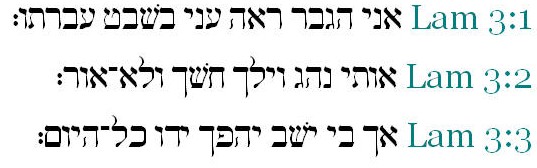
Chapter 5 has the name number of verses as the Hebrew alphabet but not in acrostic form
The road to Renewal:
Sin ====> Suffering (1:8) | Sorrow======> Repentance (1:20) | tefillah =======> Hope (3;19-24) | Faith =======>Restoration (5:21)\
Outline
1. The Awful Desolation of Yerushalayim (1;11)
2. The Sad cry, confession, and tefillah of the people (1:12-22)
A. The Cry (1:12-17)
B. The Confession (1:18,19)
C. The tefillah (1:20-22)
3. Hashem seen as the one who punished Yerushalayim (chap 2)
A. The effects of Hashem's wrath (2:1-13)
B. The cause of HaShem's wrath - the false Navis' failure to warn the people (2:14)
C. The riducule of the onlookers (2:15,16)
D. The fulfillmentment of Hashem's threats (2:17)
E. The call to teshuvah (2:18,19)
F. The tefillah of HaShem's Mercy (2:20-22)
4. HaNavi voices the sorrow and confession of the remnant (chap 3)
A. The judgments of HaShem (3:1-18)
B. The mercies of Hashem (3:19-39)
C. The call for Spiritual Renewal (3:40-42)
D. The Sorrow of Yermeyahu over Yerushalayim (3:43-51)
E. The Navi's tefillah for deliverance from His foes (4:1-20)
5. The future prospect - Edom to be destroyed and Yehudah restored (4:21,22)
6. The remnant appeals to Hashem for mercy and restoration (chap 5)