
7:1 Then came together to him the Prushim, and certain of the Sofrim, which came from Yerushalayim.
7:2 And when they saw some of His Talmidim eat lechem with ritually unclean, that is to say, with yadayim temeiot (unwashen hands), they found fault.
7:3 For the Prushim, and all the Yehudim, except they netilat yadayim (ritual wash hands) oft, eat not, observing the Masoret ha Zekenim (the Torah shebal peh, oral torah cf Gal 1:14 tradition of the Zekenim)
7:4 When they come from the marketplace, they do not eat unless they wash. And there are many other things which they have received and hold, like the washing of cups, pitchers, copper vessels, and couches.
7:5 Then the Prushim and Sofrim asked him, Why walk not your Talmidim according to the *Masoret ha Zekenim, but eat lechem with yadayim temeiot?
Rightly did Yeshayahu prophesied of you hypocrites,
As it is written:
This people honours Me with their lips, but their heart is far away from Me.
7:7 'But in vain do they worship Me, Teaching as doctrines the precepts (entalma) of men.' (Yeshayahu 29:13)
Full well you have nullified the mitzvah (entole) of Elohim, in order to keep your own tradition.
"Respect your father and your mother,' and, 'He who curses father or mother, let him be put to death.'
7:12 And you suffer him no more to do ought for his father or his mother;
7:16 If any man have oznayim (ears) to hear, let him hear.
Are you so without understanding also?
Do you not perceive, that whatsoever thing from without enters into the man, [it] cannot defile him;
7:20 And he said, That which comes out of the man, that defiles the man.
7:21 For from within, out of the heart of men, proceed evil thoughts, adulteries, fornications, murders,
7:22 Thefts, covetousness, wickedness, deceit, lasciviousness, an evil eye, blasphemy, pride, foolishness:
7:23 All these evil things come from within, and defile the man.
(Mattityahu 15:21-28)
7:24 And from thence he arose, and went into the borders of Tzor and Tzidon, and entered into an house, and would have no man know [it]: but he could not be hid.
7:25 For a certain woman, whose young daughter had an unclean spirit, heard of him, and came and fell at his feet:
7:26 The woman was a Greek, a Surophoinikissa by nation; and she besought him that he would cast forth the devil out of her daughter.
7:27 But Yehoshua (יהושע) said to her:
Let the children first be filled: for it is not meet to take the children's lechem, and to cast [it] to the dogs.
7:28 And she answered and said to Him:
Yes, Adon: yet the dogs under the table eat of the children's crumbs.
7:29 And Yehoshua (יהושע) said to her:
For this saying go your way; the devil is gone out of your daughter.
7:30 And when she was come to her house, she found the devil gone out, and her daughter laid upon the bed.
Yehoshua heals a deaf-Mute
(Mattityahu 15:29-31)
7:31 And again, departing from the coasts of Tzor and Tzidon, he came to the Yam Galil, through the midst of the coasts of Dekapolis (Δεκάπολις).
7:32 And they bring to him one that was deaf, and had an impediment in his speech; and they beseech him to put his hand upon him.
7:33 And He took him aside from the multitude, and put His fingers into his ears, and He spit, and touched His tongue;
7:34 And looking up to heaven, he sighed, and said to him, Ephphatha (εφφαθα), that is, Be opened.
7:35 And straightway his ears were opened, and the string of his tongue was loosed, and he speak plain.
7:36 And he charged them that they should tell no man: but the more he charged them, so much the more a great deal they published [it];
7:37 And were beyond measure astonished, saying:
He has done all things well: he makes both the deaf to hear, and the dumb to speak.
Ephphatha - the Greek is the root word for epiphany and also form of a Syro-Chaldaic or Aramaic word, meaning "Be opened" It is one of the characteristics of Mark that he uses the very Aramaic words which fell from our Adon's lips. (See 3:17; 5:41; 7:11; 14:36; 15:34.)
TimHegg in one of His article Tradition explains that Yehoshua (יהושע) spoke of the “traditions of the elders” by which He most likely meant “teachings of a particular rabbinic tradition” (such as of the House of Hillel or the House of Shammai), and He spoke of them in a very negative way. When judged by the Pharisees as unrighteous for not maintaining the traditions, Yehoshua (יהושע) responds (in Mark 7:6ff) by first quoting Yeshayahu (29:13):
וכך כותב החוקר הרומאי פליניוס הזקן באנציקלופדיה תולדות הטבע:
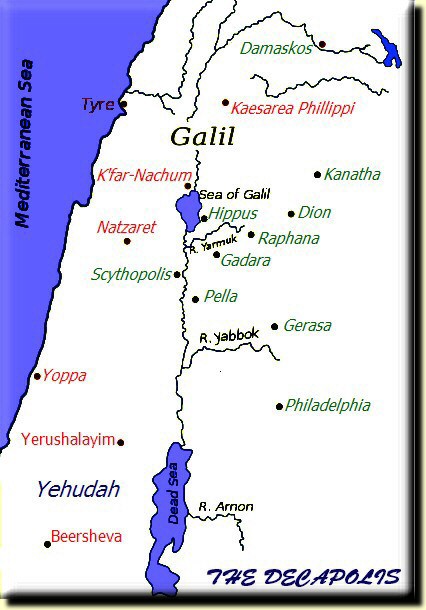
Mention Matt 4:25; Markos 5:20; Markos 7:31
1. Expelled (Jerash today) in Jordan