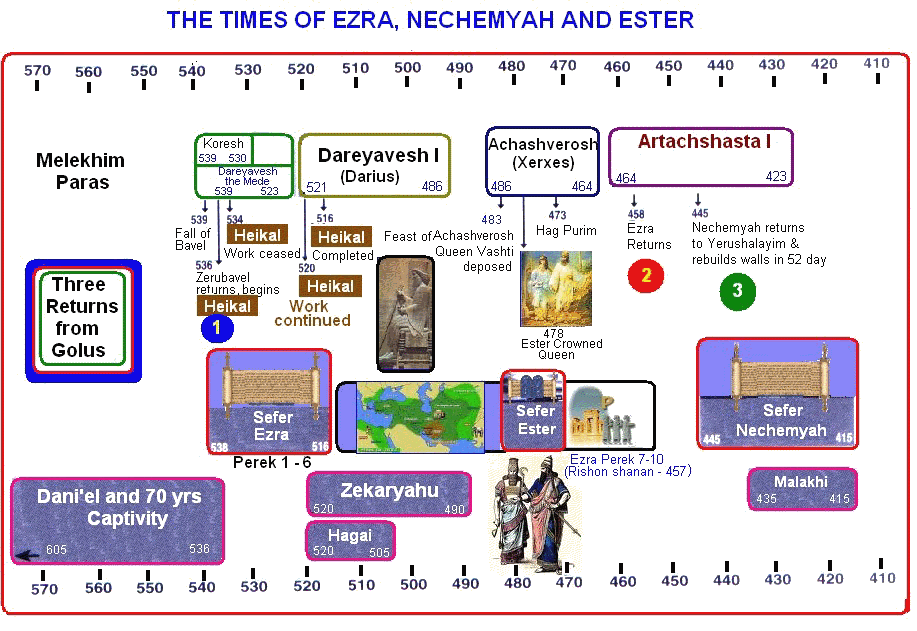
4:1 Now when the adversaries of Yehudah and Benyamin heard that banim of the captivity builded the Heikhal to ADONAI (יהוה) Elohei Yisrael;
4:2 Then they came to Zerubavel, and to Rosh ha avot, and said to them:
Let us build with you: for we seek Eloheichem, as ye [do]; and we do sacrifice to him since the days of Esar-Hadon melekh Assur, which brought us up hither. II Kings 17:24-29
4:3 But Zerubavel, and Yeshua, and the rest of the chief of avot Yisrael, said to them:
You have nothing to do with us to build a Beit to Eloheinu; but we ourselves together will build to ADONAI (יהוה) Elohei Yisrael, as melekh Koresh the melekh Paras has commanded us.
4:4 Then the people of the land weakened the hands of the people of Yehudah, and troubled them in building,
4:5 And hired counsellors against them, to frustrate their purpose, all the days of Koresh melekh Paras, even until the reign of Dareyavesh melekh Paras.
4:6 And in the reign of Achashverosh, in the beginning of his reign, wrote they [unto him] an accusation against the inhabitants of Yehudah and Yerushalayim. (486 BC)
4:7 And in the days of Artachshasta wrote Bishlam, Mitre'dat, Tav'el, and the rest of their companions, to Artachshasta melekh Paras; and the writing of the letter [was] written in the Aramaic character, and interpreted in the Aramaic tongue.
4:8 Rechum the commander and Shimshai the scribe wrote a letter against Yerushalayim to Artachshasta the melekh in this sort:
4:9 Then [wrote] Rechum the commander, and Shimshai the scribe, and the rest of their companions; the Dinaites, the Apharsathchites, the Tarpelites, the Apharsites, the Archevites, the Bavelim, the Shushanchites, the Dehavites, [and] the Elamites,
4:10 And the rest of the nations whom the great and noble Osnappar brought over, and set in the cities of Shomron, and the rest [that are] Beyond the River (Satrapy), and at such a time.
The second Letter of Ezra (עזרא) (11-16)
4:11 This [is] the copy of the letter that they sent to him,
To: Artachshasta the king;
From: Thy servants,
the men Beyond the River (Satrapy), and at such a time.
4:12 Be it known to the melekh, that the Yehudim which came up from thee to us are come to Yerushalayim, building the rebellious and the bad city, and have set up the walls [thereof], and joined the foundations.
4:13 Be it known now to the melekh, that, if this city be builded, and the walls set up [again, then] will they not pay toll, tribute, and custom, and [so] you shalt endamage the revenue of the kings.
4:14 Now because we have maintenance from [the king's] palace, and it was not meet for us to see the king's dishonour, therefore have we sent and certified the king;
4:15 That search may be made in the Sefer the records of thy fathers: so shalt you find in the Sefer the records, and know that this city [is] a rebellious city, and hurtful to kings and provinces, and that they have moved sedition within the same of old time: for which cause was this city destroyed.
4:16 We certify the melekh that, if this city be builded [again], and the walls thereof set up, by this means you shalt have no portion Beyond the River (Satrapy).
The Third Letter of melekh to Rechum 11-16
4:17 [Then] sent the melekh an answer:
Unto: Rechum the commander, and [to]
Shimshai the scribe, and [to]
the rest of their companions that dwell in Shomron, and [unto]
the rest beyond the river.
"Shelam (Peace), and at such a time."
4:18 The letter which ye sent to us has been plainly read before me.
4:19 And I commanded, and search has been made, and it is found that this city of old time has made insurrection against kings, and [that] rebellion and sedition have been made therein.
4:20 There have been mighty kings also over Yerushalayim, which have ruled over all [countries] beyond the river; and toll, tribute, and custom, was paid to them.
4:21 Give ye now commandment to cause these men to cease, and that this city be not builded, until [another] commandment shall be given from me.
4:22 Take heed now that ye fail not to do this: why should damage grow to the hurt of the kings?
4:23 Now when the copy of melekh Artachshasta' letter [was] read before Rechum, and Shimshai the scribe, and their companions, they went up in haste to Yerushalayim to the Yehudim, and made them to cease by force and power.
4:24 Then ceased the work of the Beit Elah which [is] at Yerushalayim. So it ceased to the second year of the reign of Dareyavesh melekh Paras.
Sefer Ezra (עזרא) - Elah (when Jews on foreign land or land of goyim)
Chapter 4:24;
The text stucture of Ezra (עזרא) 4. If you scan Ezra (עזרא) 4, you will notice that the word Beit or Heikal marked in verses 1-5 and then again verse 24, but is not mentioned at all from verses 6-23. This is because Ezra (עזרא) 4:6-23 is a parenthesis which interupts the chronological order:
Chapter 4:1-5 -----> 4:6-23 Parenthesis (event happen after vs 1-5) ---> City - Wall
Chapter 4:24 ----> Beit Elah
Thing to do for Ezra (עזרא) 4
List the four gentile kings and 4 things done to Yisrael under the reign of the 4 kings
4:4-5 The people of the land weakened the hands; troubled them in building, hired counsellors against them, to frustrate their purpose.
The Shomron made proposals for co-operation in the work. Zerubavel and the elders, however, declined all such cooperation, feeling that Judea must build the Heikal without help. Immediately evil reports were spread regarding the Yehudim. According to Ezra (עזרא) 4:5, the Shomron sought to "frustrate their purpose" and sent messengers to Ecbatana and Susa, with the result that the work was suspended.Ahmetha -Ecbatana אחמתא capital of Media, captured by Koresh in 550 BC and then summer residence of Persian kings
4:6 - Years later when Xerxes began his reign, the enemies of Yehudah wrote a letter of accusation against the people of Yehudah and Yerushalayim.
Reason for the accusation gave to the king
- if this city is rebuilt and its walls are completed, it will be much to the king's disadvantage, for the Yehudim will then refuse to pay their tribute, customs, and tolls to him
- requested the king to check on his ancestors' records, where he would discover what a rebellious city this has been in the past. In fact, it was destroyed because of its long and troublesome history of revolt against the kings and countries who controlled it.
The king thereupon ordered the work to stop.
Since melekh Artachshasta listen to evil report of his subject and refuse to obey the calling to allow the Yehudim to build Beit ADONAI, he ultimately loses his kingdom and Hashem raise up another gentile king to do His will. Not one can have the authority to forbid the work of HaShem be accomplished.
Achashverosh [Xerxes I 486-465 B.C.E., the husband of Queen Esther]