(Hab 1:1; Zech 1:1)
5:1 Then the neviim, Haggai ha Navi, and Zekaryah Ben Iddo, prophesied to the Yehudim that [were] in Yehudah and Yerushalayim in the Name of Elah Yisrael, [even] to them.
5:2 Then rose up Zerubavel Ben Shealtiel, and Yeshua Ben Yotzadak, and began to build Beit Elah which [is] at Yerushalayim: and with them [were] the neviim of Elah helping them.
5:3 At the same time came to them Tatnai, governor beyond the River (Satrapy), and Shetar-Boznai, and their companions, and said thus to them:
"Who has commanded you to build this house, and to make up this wall?
5:4 Then said we to them after this manner:
What are the names of the men that make this building?
5:5 But the eye of Elah was upon the savei (elders) of the Yehudim, that they could not cause them to cease, till the matter came to Dareyavesh: and then they returned answer by letter concerning this [matter].
5:6 The copy of the letter that Tatnai, governor beyond the River (Satrapy), and Shethar-Boznai, and his companions the Apharsachites, which [were] Beyond the River (Satrapy), sent to Dareyavesh the king:
5:7 They sent a letter to him, wherein was written thus:
To: Dareyavesh ha melekh,
All Shalom.
5:8 Be it known to the melekh, that we went into the province of Yehudah, to the Beit the great Elah, which is builded with great stones, and timber is laid in the walls, and this work goeth fast on, and prospereth in their hands.
5:9 Then asked we those savei (elders), [and] said to them thus, Who commanded you to build this house, and to make up these walls?
5:10 We asked their names also, to certify thee, that we might write the names of the men that [were] the chief of them.
5:11 And thus they returned us answer, saying:
We are the servants of Elah Shamayim and earth, and build the house that was builded these many years ago, which a great melekh Yisrael builded and set up.
5:12 But after that our fathers had provoked Elah Shamayim to wrath, he gave them into the hand of Nevukadnetzar the melekh Bavel, the Kasdim, who destroyed this house, and carried the people away into Bavel.
5:13 But in the first year of Koresh the melekh Bavel [the same] melekh Koresh made a decree to build this Beit Elah.
5:14 And the vessels also of zahav (gold) and kesef (silver) of the Beit Elah, which Nevukadnetzar took out of the temple that [was] in Yerushalayim, and brought them into the temple of Bavel, those did Koresh the melekh take out of the temple of Bavel, and they were delivered to [one], whose name [was] Sheshbatztzar, whom he had made governor;
5:15 And said to him, Take these vessels, go, carry them into the temple that [is] in Yerushalayim, and let the Beit Elah be builded in His place.
5:16 Then came the same Sheshbatztzar, [and] laid the foundation of the Beit Elah which [is] in Yerushalayim: and since that time even until now has it been in building, and [yet] it is not finished.
5:17 Now therefore, if [it seem] good to the melekh, let there be search made in the king's treasure house, which [is] there at Bavel, whether it be [so], that a decree was made of Koresh the melekh to build this Beit Elah at Yerushalayim, and let the melekh send his pleasure to us concerning this matter.
Sefer Ezra (עזרא) - Elah (when Jews on foreign land or land of goyim)
Chapters 5:1, 2, 5, 8, 11, 12, 13, 14, 15, 16, 17
Cambyses or Cambese (Greek: Καμβύσης; Old Persian Kambujiya) is the name of three members of the Achaemenid line of ancient Persia:
The same name appears as Kambujiya (or perhaps Kambaujiya or Kamboujiya) in Old Persian, as Kamboja in the Indian epic Mahabharata, as C-n-b-n-z-y in Aramaic, Kambuzia in Assyrian, Kambythet in Egyptian, Kam-bu-zi-ia in Akkadian, Kan-bu-zi-ia in Elamite, and Kanpuziya in Susian language. It appears to have been a very popular name among ancient Iranians. The royal Old Persian name Kambujiya or Kambaujiya of the Achaemenid line has been linked [4] with the Sanskrit/ Pāli ethnonym Kamboja, origin of modern Cambodia, (also appearing on Ashoka's Rock Edicts ).
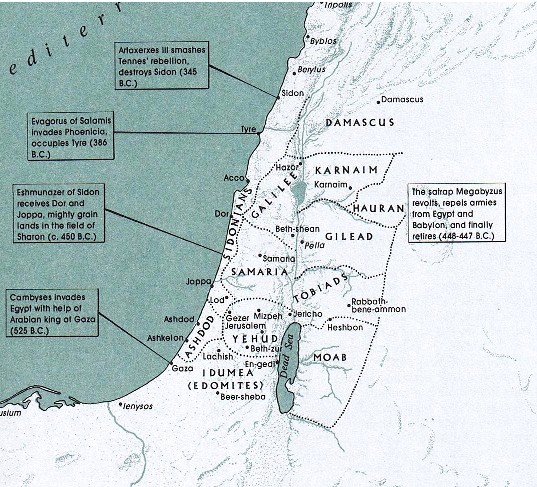
Cambyses marched down the coast of Egypt and got the assistance of the Arbians holding the Gaza-lenysos coastal strip (525 BC)in return for special economic status. It is hardly a coincidence that troubles with Egypt coincided with accusation against the Jews to Yehud. The satrap of Egypt was minting coins without permission in the second year Darius when Tattenai tried to Zerubbabel's building the temple (Ezra (עזרא) 4:24-6:15). Egypt was in revolt during Xerxes accession year (486 BC Ezra (עזרא) 4:6)