 ;
;
1:1
Now it came to pass after the death of Sha'ul, when David was
returned from the slaughter of the Amalekites, and David had
abode two days in Ziklag;
1:2 It came even to pass on the third day, that, behold, a man came out of the camp from Sha'ul with his clothes rent, and earth upon his head: and [so] it was, when he came to David, that he fell to the earth, and did obeisance.
And David said unto him:
From whence comest thou?
And he said unto him:
Out of the camp of Yisra'el am I escaped.
And David said unto him:
How went the matter? I pray thee, tell me.
And he answered:
That the people are fled from the battle, and many of the people also are fallen and dead; and Sha'ul and Yonatan his son are dead also.
And David said unto the young man that told him:
How knowest thou that Sha'ul and Yonatan his son be dead?
And the young man that told him said:
As I happened by chance upon mount Gilboa, behold, Sha'ul leaned upon his spear; and, Hinnei, the chariots and horsemen followed hard after him.
And when he looked behind him, he saw me, and called unto me. And I answered: "Here [am] I. "
And he said unto me:
Who [art] thou?
And I answered him:
I [am] an Amalekite.
He said unto me again:
Stand, I pray thee, upon me, and slay me: for anguish is come upon me, because my life [is] yet whole in me.
So I stood upon him, and slew him, because I was sure that he could not live after that he was fallen: and I took the crown that [was] upon his head, and the bracelet that [was] on his arm, and have brought them hither unto my adon (אדון).
1:11 Then David took hold on his clothes, and rent them; and likewise all the men that [were] with him:
1:12 And they mourned, and wept, and fasted until even, for Sha'ul, and for Yonatan his son, and for the people of YHWH (יהוה), and for the beit Yisra'el; because they were fallen by the sword.
And David said unto the young man that told him:
Whence [art] thou?
And he answered:
I [am] Ben a stranger, an Amalekite.
And David said unto him:
How wast thou not afraid to stretch forth thine hand to destroy YHWH (יהוה)'S anointed?
And David called one of the young men, and said,
Go near, [and] fall upon him. And he smote him that he died.
And David said unto him:
Thy blood [be] upon thy head; for thy mouth hath testified against thee, saying:
"I have slain YHWH (יהוה)'S anointed."
1:17 And David lamented with this lamentation over Sha'ul and over Yonatan his son:
Ve yomer le lamed (teach) Benai Yehudah:
Keshet (archer קשׁת). Hinnei, ne ketuvah (it is written) al- Sefer ha Yashar:
The beauty of Yisra'el is slain upon thy high places: how are the mighty fallen!
Tell [it] not in Gat, publish [it] not in the streets of Askelon; lest the daughters of the Pelishtim rejoice, lest the daughters of the uncircumcised triumph.
Ye mountains of Gilboa, [let there be] no dew, neither [let there be] rain, upon you, nor fields of offerings: for there the shield of the mighty is vilely cast away, the shield of Sha'ul, [as though he had] not [been] anointed with oil.
From the blood of the slain, from the fat of the mighty, the bow of Yonatan turned not back, and the sword of Sha'ul returned not empty.
Sha'ul and Yonatan [were] lovely and pleasant in their lives, and in their death they were not divided: they were swifter than eagles, they were stronger than lions.
Ye daughters of Yisra'el, weep over Sha'ul, who clothed you in scarlet, with [other] delights, who put on ornaments of gold upon your apparel.
How are the mighty fallen in the midst of the battle!
O Yonatan, [thou wast] slain in thine high places.
I am distressed for thee, my brother Yonatan: very pleasant hast thou been unto me: thy love to me was wonderful, passing the love of women.
How are the mighty fallen, and the weapons of war perished!
After the death of Shaul, David becomes king over Yehudah for seven and a half years and then king of all Yisrael where he makes Yerushalayim his capital. His reign in Yerushalayim lasted thirty-three years. In this forty-year span, David enjoyed outstanding military successes, was blessed with great wealth, and entered into an everlasting covenant with Hashem that his throne would last forever. A thousand years later, Hashem fulfilled His promise by sending Adonay Yeshua ha Moshiach to be the moshia of the world.
In sefer ha Shemuel Bet, we shall meet David as a picture ofYeshua. The book also chronicles the person of David – his triumphs, and fears, his sins of adultery and murder which brought personal and national chastening from Hashem. Yet, David continued to seek Hashem zealously, repenting of his sins as befitting the one called by Hashem “a man after My own heart” (Acts 13:22).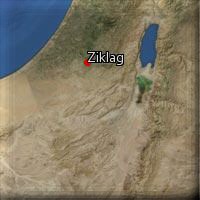
Ziklag was located in the Negev region in the south of what was the Kingdom of Yehudah. Its exact location has not been identified with any certainty, though by the end of the 19th century, both Haluza (by the Wadi- Aslu to the south of Beersheba) and Khirbet Zuheiliqah (located to the north west of Beer-Sheva and south southeast of Gaza city) had been suggested . Ziklag is generally agreed to be a significant corruption of the location's actual name ; Haluza was identified as the location on the basis of Ziklag being a corruption of Halusah (slightly clearer in the underlying Hebrew script than in English), meaning fortress; Khirbet Zuheiliqah was identified as the location on the basis of Ziklag being a corruption of Zahaliku, which means downward slopes and is descriptive of Khirbet Zuheilikah's location . The excavators of Tell Zeitah have suggested it as a possible location of Ziklag.
The Book of Genesis refers to an individual named Casluhim as the founder of the Pelishtim, and it is thought possible that the name is a corruption of Halusah; with the identification of Ziklag as Haluza, this suggests that Ziklag was the original base from which the Pelishtim captured the remainder of their territory. It has also been proposed that Ziklag subsequently became the capital of the Cherethites .
According to the Sefer ha Shemuel Bet, while David was encamped with the Philistine army for an attack on the Kingdom of Yisra'el, Ziklag was raided by Amalekites; the Amalekites burning the town, and capturing its population without killing them (scholars think this capture refers to enslavement ). However, none of the archaeological sites which have been variously suspected to be Ziklag show any evidence of destruction during the era of David.