
19:1 Then Pilatos therefore took Yeshua (יֵשׁוּע), and scourged him.
19:2 And the soldiers platted a crown of thorns, and put it on his head, and they put on Him a purple robe,
19:3 And said, Shalom to you, Melekh Yehudim! and they smote Him with their hands.
19:4 Pilatos therefore went forth again, and said to them, Hinnei, I bring Him forth to you, that you may know that I find no fault in Him.
19:5 Then came Yeshua (יֵשׁוּע) forth, wearing the crown of thorns, and the purple robe. And Pilatos said to them, Hinnei the man!
19:6 When Rashei ha Kohenim therefore and officers saw Him, they cried out, saying, Impale him, Impale him.
Pilatos said to them,
"Take you Him, and Impale him:
for I find no fault in Him."
19:7 The Yehudim answered Him, We have a Torah, and by our Torah he ought to die, because he made himself BEN Elohim (אלוה).
19:8 When Pilatos therefore heard that saying:
he was the more afraid;
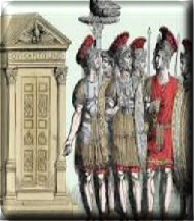
19:9 And went again into the Praitorion, and said to Yeshua (יֵשׁוּע), "where are You from? But Yeshua (יֵשׁוּע) gave him no answer.
19:10 Then said Pilatos to Him, "Are You not speaking to me? Do not know that I have power to Impale You, and have power to release You?
19:11 Yeshua (יֵשׁוּע) answered,
"You could have no power at all against Me unless it had been given you from above. Therefore the one who delivered Me to you has the greater sin."
19:12 From then on Pilatos sought to release Him: but the Yehudim cried out, saying, "If you let this Man go, you are not Kaisar's friend: Whoever makes himself a king speaks against Kaisar."
19:13 When Pilatos therefore heard that saying, he brought Yeshua (יֵשׁוּע) forth, and sat down in the judgment seat in a place that is called "the Pavement", but in the Aramaic, Gabta.
19:14 And it was Erev Pesach and about the sixth hour (12 noon): and he said to the Yehudim, "Hinnei your Melekh!"
19:15 But they cried out,
Away with him, away with him, Impale Him. Pilatos said to them, Shall I Impale your Melekh? The Rashei Kohenim answered, We have no king but Kaisar.
19:16 Then delivered he Him therefore to them to be Impaled. And they took Yeshua (יֵשׁוּע) and led Him away.
19:17 And he bearing His stauros (Roman stake), He went forth into a place called the Mekom ha Gulgolet, which is called in the Aramaic Gulgota (Gûlgaltâ גֻּלְגֹּלֶת )
19:18 Where they Impaled Him, and two other with Him, on either side one, and Yeshua (יֵשׁוּע) in the midst.
19:19 And Pilatos wrote a title, and put it on the stauros (Roman stake). And the writing was, Yeshua (יֵשׁוּע) Natzeret haMelekh Yehudim.
19:20 This title then read many of the Yehudim: for the place where Yeshua (יֵשׁוּע) was Impaled was nigh to the city: and it was written in Hebrew, and Greek, and Latin.
19:21 Then said the Rashei Kohenim of the Yehudim to Pilatos, Write not, The Melekh of the Yehudim; but that he said, I am Melekh of the Yehudim.
19:22Pilatos answered, What I have written I have written.
19:23 Then the soldiers, when they had Impaled Yeshua (יֵשׁוּע), took his garments, and made four parts, to every soldier a part; and also His ketonet (tunic): now the ketonet was without seam, woven from the top throughout. (Vayikra 16:4; Tehillim 110:4)
19:24 They said therefore among themselves, Let us not rend it, but cast lots for it, whose it shall be: that the scripture might be fulfilled, which said, They parted my raiment among them, and for my vesture they did cast lots. These things therefore the soldiers did.
19:25 Now there stood by the stake of Yeshua (יֵשׁוּע) his mother, and his mother's sister, Miriyam the [wife] of Klopas, and Miryam Magdalene.
19:26 When Yeshua (יֵשׁוּע) therefore saw his mother, and the taught one standing by, whom he loved, he said to his mother, Woman, Hinnei thy son!
19:27 Then said he to the taught one, Hinnei thy mother! And from that hour that the taught one took her to his own home.
19:28 After this, Yeshua (יֵשׁוּע) knowing that all things were now accomplished, that the scripture might be fulfilled, said, I thirst.
19:29 Now there was set a vessel full of vinegar: and they filled a spunge with vinegar, and put it upon ezob (hyssop), and put it to his mouth.
19:30 When Yeshua (יֵשׁוּע) therefore had received the vinegar, he said, It is finished: and He bowed His head, and gave up the neshamah (pneuma, spirit).
19:31 The Yehudim therefore, because it was the preparation, that the bodies should not remain upon the stake on the Shabbat, (for that Yom Shabbat ha Gadol,) besought Pilatos that their legs might be broken, and [that] they might be taken away.
19:32 Then came the soldiers, and brake the legs of the first, and of the other which was Impaled with Him.
19:33 But when they came to Yeshua (יֵשׁוּע), and saw that He was dead already, they brake not His legs:
19:34 But one of the soldiers with a spear pierced His side, and forthwith came there out blood and mayim.
19:35 And he that saw it bare record, and his record is true: and he knows that he said true, that you might believe.
19:36 For these things were done, that the scripture should be fulfilled, A bone of Him shall not be broken.
19:37 And again another scripture said, They shall look on Him whom they pierced.
19:38 And after this Yosef of Ramatayim, being a the taught one of Yeshua (יֵשׁוּע), but secretly for fear of the Yehudim, besought Pilatos that he might take away the body of Yeshua (יֵשׁוּע): and Pilatos gave [him] leave. He came therefore, and took the body of Yeshua (יֵשׁוּע).
19:39 And there came also Nakdimon, which at the first came to Yeshua (יֵשׁוּע) by night, and brought a mixture of myrrh and aloes, about an hundred pound [weight].
19:40 Then took they the body of Yeshua (יֵשׁוּע), and wound it in linen clothes with the spices, as the manner of the Yehudim is to bury.
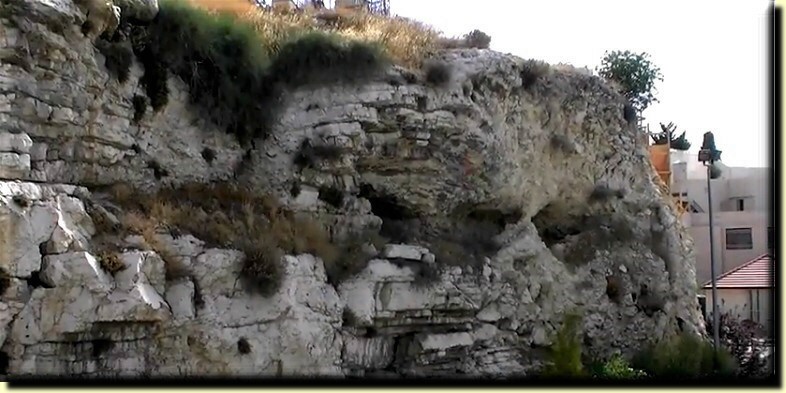
Vayikra 1:11 - North side - Yochanan 19:41 - a garden
19:41 Now in the place where he was Impaled there was a garden; and in the garden a new kever (tomb), wherein was never man yet laid.
19:42 There laid they Yeshua (יֵשׁוּע) therefore because of the Yehudim' Erev Pesach (preparation day); for the kever (tomb) was nigh at hand.
Yosef of Ramatayim הָרָמָתַ֛יִם in Biblical times of Tenakh (1 Shemuel 1:1)(Mattityahu 27:57, Markos 15:43, Yochanan 19:38 Loukas 23:50) and Nakdimon (Yochanan 3:1, Yochanan 7:50) were two highly placed Messianic Jews, both members of the Sanhedrin (Loukas 23:50-51, Yochanan 7:50-52); both secret believers. he should, after acquiring some knowledge enabling him to defend his views (1 Kefa 3:15-16), be willing to set fear aside and stand openly with Yeshua the Messiah. Yochanan does not disparage them for hiding their faith (see Yochanan 9:22, Loukas 12:8-9).
He should, after acquiring some knowledge enabling him to defend his views (1 Kefa 3:15-16), be willing to set fear aside and stand openly with Yeshua the Messiah. Yochanan does not disparage them for hiding their faith (see Yochanan 9:22, Loukas 12:8-9). YirmeYahu
Gibeat Goath Goah or the Hill of Death (of roaring, groaning) is a hill near Yerushalayim, mentioned in YirmeYahu 31:39. YirmeYahu predicts (YirmeYahu 31:36-40) that the city should in future times extend beyond the north wall (the second wall) and inclose Gibeat Gareb and Gibeat Goath. The position of Gareb can correspond only with Under Bezetha, and the position of Goath only with Upper Bezetha where Golgotha rose. From the context we learn that Gareb and Goath were unclean places, but, being measured in with the holy city, became sanctified. That the Goath hill of YirmeYahu is identical with the Golgotha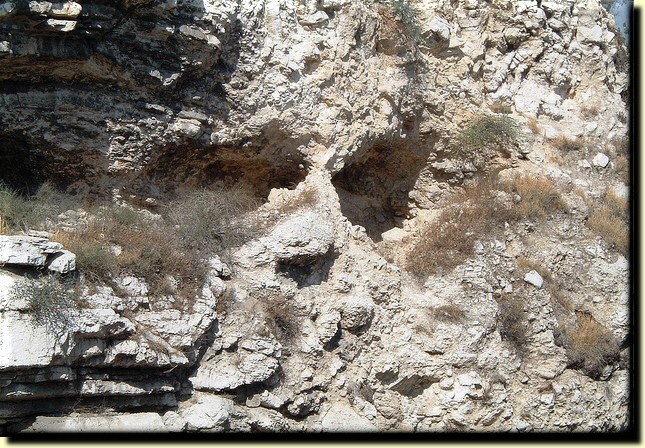
Most crucifixion victims died within hours, or days, in unspeakable agony. This could come by infection, thirst, exposure, animals, blood loss, or shock. In most cases, Roman crucifixion ended in suffocation, as victims lost the strength to push against their impaled limbs to breathe. To speed this up, executioners might use a heavy rod to shatter the victim's shin bones. Yeshua has been crucified alongside two men (Yochanan 19:18), who suffer this fate (Yochanan 19:31–32). Yeshua had been savagely maimed before being crucified (Yochanan 19:1), however, so He has already died (Yochanan 19:30). This is obvious enough to the executioners that they don't even make the effort to break His legs (Yochanan 19:32).
For whatever reason, one of the attending soldiers decides to be sure Yeshua is really dead. A spear thrust is much quicker and easier than a messy blow to the legs, especially when one knows the target is already dead. The result of this attack is a gush of blood and water. Yochanan, who describes this scene, was very close to Yeshua when it happened (Yochanan 19:25–27). The gory, graphic image of bodily fluids pouring out of Yeshua' side left no doubt that He was dead. Were Yeshua in perfect health prior to this moment, such an injury would have been fatal. In this situation, it's evidence that Yeshua succumbed to blood loss and shock as fluid built up around His heart. There is no question, at all, that He's dead.
Among the sillier claims made about Yeshua is that He survived the crucifixion. Some claim He then pretended to have been resurrected, or simply escaped.
What Yeshua experienced, however, was enough to kill Him several times over. Scourging victims often died from their injuries (Yochanan 19:1).
Infection, shock, and blood loss from crucifixion were fatal (Yochanan 19:18). Having a spear impaled through the chest, resulting in a gush of fluid, is an immediately lethal wound. A person left locked in a tomb for three days would have succumbed to infection and dehydration (Matthew 28:1–10).
In the Year 1982 Ron Wyatt discovered the crack that lead to where the Ark of Covenant discovered traces of blood, located in a chamber beneath the crucifixion site in Yerushalayim. Wyatt claimed this blood, when tested, appeared "alive" and contained only 24 chromosomes (23 from Mary and 1 Y-chromosome). see the video 1 video 2
There is no reasonable way to suggest that Yeshua survived all these things, only to convince people later that He was a victorious, resurrected Messiah.
Having a first-hand look at this graphic scene, and knowing that Yeshua is indisputably dead, leads Yochanan to emphasize His own account in the next few verses (Yochanan 19:35).