
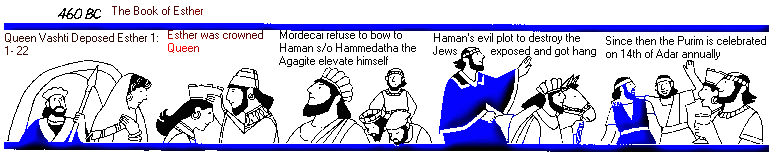
Ester pleads for herself and her people
Does it pay for hating the Jewish people?
Queen Vasti, Haman and family all
paid a very high price for their deadlly action
7:1
So ha melekh and Haman (המן) came to mishteh (banquet) with Ester ha malkah (מלכּה).
7:2
And ha melekh said again to Ester on the second day at the
mishteh (banquet) of wine, What [is] thy petition, malkah (מלכּה) Ester? and it
shall be granted thee: and what [is] thy request? and it shall
be performed, [even] to the half of the kingdom.
7:3
Then Ester ha malkah (מלכּה) answered and said,
If I have found
favour in thy sight, O melekh, and if it please ha melekh, let my
life be given me at my petition, and my people at my request:
7:4
For we are sold, I and my people, to be destroyed, to be
slain, and to perish. But if we had been sold for bondmen and
bondwomen, I had held my tongue, although the enemy could not
countervail ha melekh's damage.
7:5
Then ha melekh Achashverosh answered and said to Ester ha malkah (מלכּה), Who is he, and where is he, that durst presume in his
heart to do so?
7:6
And Ester said, The adversary and enemy [is] this wicked
Haman (המן). Then Haman (המן) was afraid before ha melekh and ha malkah (מלכּה).
7:7
And ha melekh arising from the mishteh (banquet) of wine in his wrath
[went] into the palace garden: and Haman (המן) stood up to make
request for his life to Ester ha malkah (מלכּה); for he saw that there
was evil determined against him by ha melekh.
7:8
When ha melekh returned from the palace garden to the
place of the mishteh (banquet) of wine; and Haman (המן) had fallen across the
couch where Ester [was]. Then ha melekh
said, "Will he also assault the queen while I am in the house?" As
word left ha melekh's mouth, they covered Haman (המן)'s face.
7:9
And Harbonah, one of the chamberlains, said before ha melekh,
Behold also, the gallows fifty cubits high, which Haman (המן) had
made for Mordechai (מרדּכי), who had spoken good for ha melekh, standeth
in the beit Haman (המן). Then ha melekh said, Hang him thereon.
7:10
So they hanged Haman (המן) on the gallows that he had prepared
for Mordechai (מרדּכי). Then was ha melekh's wrath pacified.
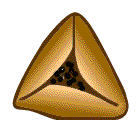 Oznei Haman (Hebrew: אוזני המן), Hebrew for "Haman's ears" The hamantash (or hamentasch, see: Other names; Yiddish המן־טאַש) is a filled-pocket cookie or pastry in Ashkenazi Jewish cuisine
recognizable for its three-cornered shape. The shape is achieved by
folding in the sides of a circular piece of dough, with a filling placed
in the center. It is traditionally eaten during the Jewish holiday of Purim.
While occasionally seen other times of year in secular contexts, this
is not traditional.
Oznei Haman (Hebrew: אוזני המן), Hebrew for "Haman's ears" The hamantash (or hamentasch, see: Other names; Yiddish המן־טאַש) is a filled-pocket cookie or pastry in Ashkenazi Jewish cuisine
recognizable for its three-cornered shape. The shape is achieved by
folding in the sides of a circular piece of dough, with a filling placed
in the center. It is traditionally eaten during the Jewish holiday of Purim.
While occasionally seen other times of year in secular contexts, this
is not traditional.
Hamantash is also known as hamentasch, homentash, homentasch, or even (h)umentash. The name "hamantash" (Yiddish: המן־טאַש), is commonly known as a reference to Haman, the villain of Purim, as described in the Book of Esther. Another folk story is that Haman wore a three-cornered hat ---thus the shape. Hamantashen can cause drug tests for opiates to show up positive if eaten in large amounts due to the amount of poppyseeds in them.
Hamantashen are made with many different fillings, including poppy seed (the oldest and most traditional variety),
[1] prunes, nut, date, apricot, apple, fruit preserves, cherry, chocolate, dulce de leche, halva, or even caramel or cheese.
[2] Their formation varies from hard pastry to soft doughy casings.