
ADONAI ish milkhamah: ADONAI shemo:
Moshe and Miriyam Song - Shemot 15 like wave of the sea - Read in Hebrew click here
the "end of each line in determined poems" (סוף שורה בשירות מסויימות - eg: Shemot 15:1-19) and a "blank line" (or "blank lines at the end of a book" - שורות ריקות בסוף ספר). a picture of Sea wave.
The Song of the Sea (Hebrew: שירת הים, Shirat HaYam, also known as Az Yashir Moshe) The poem is included in Jewish prayer books, and recited daily in the morning shacharit services.15:1 Then yashir (will sang) Moshe and the benai Yisrael this song to ADONAI (יהוה), and spake, saying:
Ashir (I will sing) la ADONAI (יהוה), for he hath triumphed gloriously: the horse and his rider hath he thrown into the sea.
YAH [is] my strength and song, and
HE is become my YESHUAH (ישׁועה):
HE [is] my ELOHIM (אלהים), and
I will prepare him an habitation;
my father's Elohim (אלהים), and
I will exalt Him.
15:3
ADONAI ish milkhamah: ADONAI
shemo:
ADONAI (יהוה) [is] a man of war:
ADONAI [is] His NAME.
Paroh's chariots and his host hath he cast into the sea: his chosen captains also are drowned in the Yam Suf (Sea of Reed).
The depths have covered them:
They sank into the bottom as a stone.
Thy right hand, O ADONAI, is become glorious in power:
Thy right hand, O ADONAI, hath dashed in pieces the enemy.
And in the greatness of Thine excellency
Thou hast overthrown them that rose up against thee:
Thou sentest forth thy wrath, [which] consumed them as stubble.
And with the blast of Thy nostrils the waters were gathered together, the floods stood upright as an heap, [and] the depths were congealed in the heart of the sea.
15:9 The enemy said:
I will pursue,
I will overtake,
I will divide the spoil; my lust shall be satisfied upon them;
I will draw my sword, my hand shall destroy them.
Thou didst blow with Thy wind, the sea covered them:
They sank as lead in the mighty waters.
Mi chamochah ba'elim, (Who [is] like to Thee)
O ADONAI (יהוה), among the gods?
Who [is] like Thee, glorious in Kodesh, fearful [in] praises, doing wonders?
Thou stretchedst out Thy right hand,
The earth swallowed them.
Thou in Thy chesed hast led forth the people [which] thou hast redeemed:
Thou hast guided [them] in Thy strength to thy set apart habitation.
The people shall hear, [and] be afraid:
Sorrow shall take hold on the inhabitants of Peleshet.
Then the dukes of Edom shall be amazed; the mighty men of Mo'av, trembling shall take hold upon them; all the inhabitants of Kenaan shall melt away.
Fear and dread shall fall upon them;
By the greatness of Thine arm they shall be [as] still as a stone;
Till Thy people pass over, O ADONAI (יהוה),
Till the people pass over, [which] Thou hast purchased.
Thou shall bring them in, and plant them in the mountain of Thine inheritance, [in] the place, O ADONAI (יהוה), [which]
Thou hast made for thee to dwell in, [in] ha Mikdash,
O Adonay, [which] Thy hands have established.
ADONAI (יהוה) shall reign for ever and ever.
For the horse of Paroh went in with his chariots and with his horsemen into the sea, and ADONAI (יהוה) brought again the waters of the sea upon them; but the benai Yisrael went on yabashah (dry, land) in the midst of the sea.
(Bamidbar 26:59) compare with Luke 1:44-55 - Miriyam
15:20 And Miryam the neviah (Prophetess), the sister of Aharon, took a timbrel in her hand; and all the women went out after her with timbrels and with dances.
15:21 And Miryam answered them:
Sing you to ADONAI (יהוה), for he hath triumphed gloriously; the horse and his rider hath he thrown into the sea.
15:22 So Moshe brought Yisrael from the Yam Suf, and they went out into the midbar of Shur; and they went three days in the midbar, and found no water.
15:23 And when they came to Marah, they could not drink of the waters of Marah, for they [were] bitter: therefore the name of it was called Marah.
15:24 And the people murmured against Moshe, saying:
What shall we drink?
15:25 And he cried to ADONAI (יהוה); and ADONAI (יהוה) shewed him a tree, [which] when he had cast into the waters, the waters were made sweet: there he made for them a statute and an ordinance, and there he proved them,
15:26 And said:
If thou wilt diligently Shama Ha Kol ADONAI (יהוה) Eloheicha, and wilt do that which is yashar in His sight, and wilt give ear to His mitzvah, and keep all His statutes,
I will put none of these diseases upon thee, which I have brought upon the Mitzrites: for ANI ADONAI (יהוה) that heals thee.
And they came to Elim, where [were] twelve wells of water, and threescore and ten palm trees: and they encamped there by the waters.
Shacharit --> Pesukei dezimra (Aramaic: פְסוּקֵי דְּזִמְרָא, P'suqế dh'zimra "hymnal verses") or zemirot Mizmor Shir (Psalm 30) Barukh she'amar Songs of thanksgiving (Psalm 100) Yehi kevod Hallel (Ashrei Psalms 146 147 148 149 150) Baruch Adonai L'Olam Vayivarech David Atah Hu Adonai L'Vadecha Az Yashir Yishtabach
Shirat HaYam (Hebrew: שִׁירַת הַיָּם, lit. Song of the Sea) refers to the song of victory that Moshe and the Yisraelites sang after crossing the Sea of Reeds - Yam Suf to escape the pursuing Mitzrayim. It is also called by its first two Hebrew word Az Yasir - The Sang (Moshe). By extolling Elohim's saving power, it becomes an affirmation of our belief in Elohim's role in history, and an acceptance of His Sovereignty over all the earth. If the Psalm of the Pesukei d'Zimra depict Elohim's might in the works of nature, Shirat HaYam describes how He revealed His might in history and in the affairs of nations, Shirat HaYam expresses Yisrael's faith in Elohim, the result of the people's encounter with His wondrous miracles. "This is my Elohim and I will glorify Him" sang our ancestors as we do today.The Ketubá del Seten Dia de Pesah (or כתובה ליום השביעי של פסח - Ketuba Le-yom Ha-shebi`i shel Pesah) is a liturgical poem in Ladino, describing Pharaoh's defeat in the Sea of Reeds. Most Yehudit communities sing this poem on 21 Nisan, the seventh day of Passover. According to Jewish tradition, this is the day on which Pharaoh's army was drowned in the Sea of Reeds, and the Yisraelite people sang the Song of the Sea in gratitude for this victory.
The song at the sea is included in the siddur toward the end of Pesukei d' Zimrah
Great and marvellous [are] thy works, Adonay Elohim (אלהים) Almighty; tzedek (just) and emet (true) [are] Thy derakhim, Thou Melekh haGoyim.Miriyam - is called the Prophetess. She spoke authoritatively from Hashem
shacharit (Hebrew: שַחֲרִת) is the daily morning Tefillah (prayer) of the Jewish people, one of the three times there is prayer each day. It is commemorating the Tamid Shel Shachar sacrifice offered in the Holy Temple every morning.
Devorah - Judge 4:4;
Wife of Yeshayahu -Isa 8:3;
Huldah 2 Kings 22:14
Redeemed gaal use in Ruth 4:4; Isaiah 43:14; to protect family rights
How did the Yisra'elites have tambourines in the desert?
The righteous women of that generation were certain that Hashem would perform miracles for them, so they prepared tambourines and dances while still in Mitzrayim.
(Rashi and Mechilta on Shemot 15:20)
Messianic dance has its roots in the Song at the Sea. After Moshe and the Benai Yisrael had finished singing the great hymn of Shemot 15, Moshe’ older sister, Miryam, took a timbrel in her hand and led the women in song and dance. Biblical dance was an expression of celebration. For example, when King David victoriously returned from battle with the Plishtim, the women of Yisra'el came out singing and dancing to meet him. When King David brought the ark of the covenant into Yerushalayim, he danced before it all the way into the city. HaNavi Yirmeyahu tells us that when the Moshiach comes, there will be dancing. “Then the virgin will rejoice in the dance, and the young men and the old, together” (Yirmeyahu 31:13).
Dance was a natural expression of joy and worship in ancient Yisra'el. (Psalms 68:25; 149:3; 150:4)
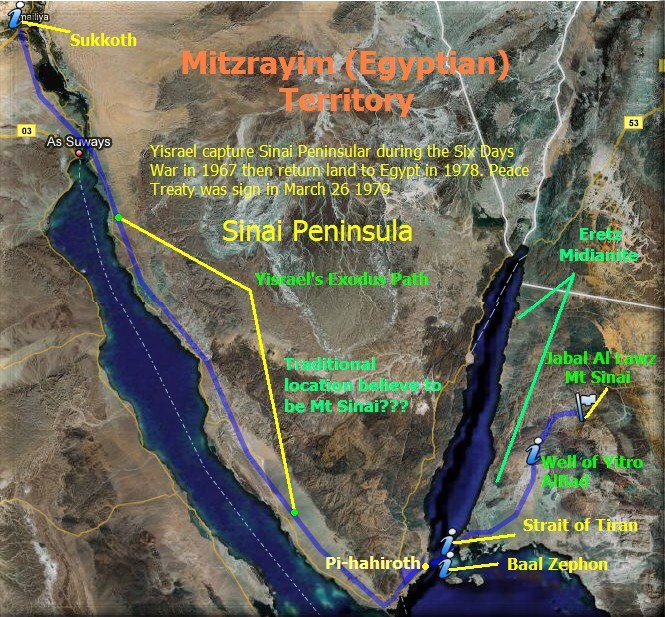
Jabal al-Lawz (Arabic: جبل اللوز) is a mountain located in northwest Saudi Arabia. It is located at 28 degrees 41 minutes north by 35 degrees 18 minutes east. It is 2403 meters/7384 feet tall. Two men found the route of Exodus and Mount Sinai - Bob Cornure and Larry Williams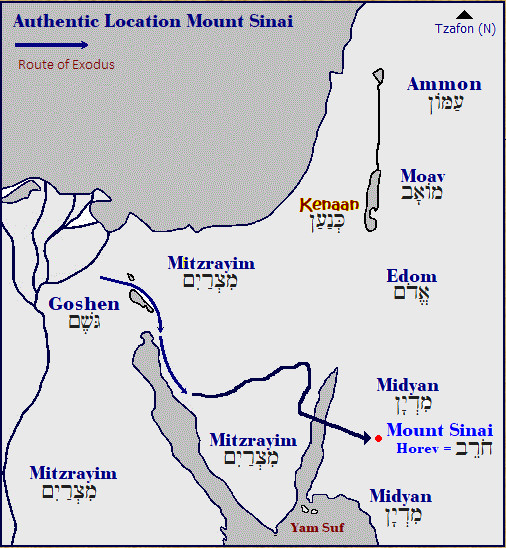
Marah BDB Definition: 1) from, out of, on account of, off, on the side of, since, above, than, so that not, more than (preposition) 1a) from (expressing separation), Bitter
Elim means "place of Trees". It has 70 Palms and 12 springs
