 Parashah for Shemot
1st Portion | 2nd Portion | 3rd Portion | 4th Portion | 5th Portion | 6th Portion | 7th Portion | Maftir


Veeleh Shemot Benei Yisrael habaim Mitzraimah et Ya'akov ish uveito bau:
Now these are the names children of Yisrael, who came into Mitzrayim; each man and his household came with Ya'akov.
1:2 Reuven (ראוּבן), Shimeon, Levy Yehudah;
1:3 Yisakhar, Zevulun and Benyamin,
1:4 Dan and Naftali, Gad, and Asher

Vayehi kol-nefesh yotzei yerekh-Ya'akov shivim nafesh veYosef hayah veMitzrayim:
And all the souls that came out of the loins of Ya'akov were seventy souls: for Yosef was in Mitzrayim already.
1:6 And Yosef died, and all his brethren, and all that generation.
1:7 And Benai Yisrael were fruitful, and increased abundantly, and multiplied, and waxed exceeding mighty; and the land was filled with them.
1:8 Now there arose up a new king over Mitzrayim, which knew not Yosef.
1:9 And he said to his people:
"Behold, the people of Benai Yisrael are more and mightier than we:
1:10 Come on, let us deal craftily with them; lest they multiply, and it come to pass, in the event of war, that they also join our enemies and fight against us, and so go up out of the land."
1:11 Therefore they did set over them taskmasters to afflict them with their burdens. And they built for Paroh (פּרעה) store cities, Pithom and Ra'amses.
1:12 But the more they afflicted them, the more they multiplied and grew. And they were grieved because of Benai Yisrael.
1:13 And the Mitzrites enslaved Benai Yisrael with back breaking labour.
1:14
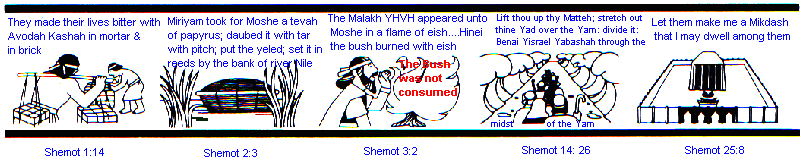
 And they made their lives bitter with avodah
kashah, in
mortar, and in brick, and in all manner of service in the
field: all their service, wherein they made them serve, was
with rigour.
And they made their lives bitter with avodah
kashah, in
mortar, and in brick, and in all manner of service in the
field: all their service, wherein they made them serve, was
with rigour.
1:15 And the king of Mitzrayim spoke to the Hebrew midwives, of which the name of the one was Shifrah, and the name of the other Pu'ah:
1:16 And he said, When you do the office of a midwife to the Hebrew women, and see them upon the stools; if it be a son, then you shall kill him: but if it be a daughter, then she shall live.
1:17 But the midwives feared Elohim, and did not as the king of Mitzrayim commanded them, but saved the men benai alive.
1st Portion | 2nd Portion | 3rd Portion | 4th Portion | 5th Portion | 6th Portion | 7th Portion | Maftir
1:18 (ii) And the king of Mitzrayim called for the midwives, and said to them:
"Why have you done this thing, and have saved the men the children alive?"
1:19 And the midwives said to Paroh (פּרעה), Because the Hebrew women are not as the Mitzrites women; for they are lively, and are delivered ere the midwives come in to them.
1:20 Therefore Elohim dwelt well with the midwives: and the people multiplied, and waxed very mighty.
1:21 And it came to pass, because the midwives feared Elohim, that He made them houses.
1:22And Paroh
(פּרעה) charged all his people, saying: "Every son that
is born you shall cast into the river, and every daughter you
shall save alive."


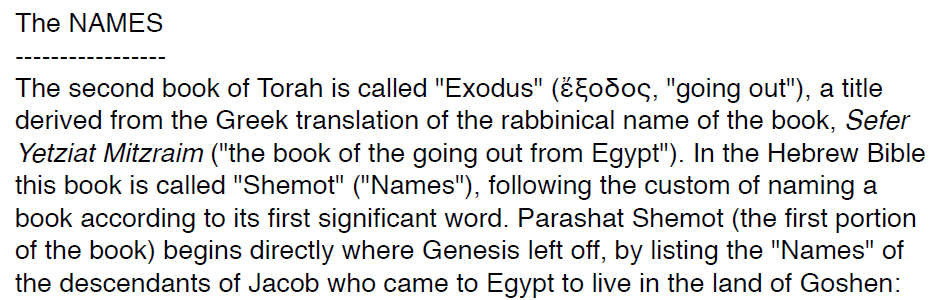
Three evil rulers in Scripture ordered the slaughter of innocent children: Paroh (פּרעה), Atalyah (2 Kgs. 11), and Herod ( Matt. 2). These satanically inspired atrocities were aimed at the extinction of the Messianic line. satan had never forgotten Elohim's promise in Beresheet 3:15.
1:11- store cities: Heb. מִסְכְּנֹתעָרֵי. As the Targum renders: קִרְוֵי בֵיתאוֹצָרָא, cities of storehouses]
"seventy-five" souls came with Ya'akov down to Mitzrayim.
Shivim Yordei Mitzrayim
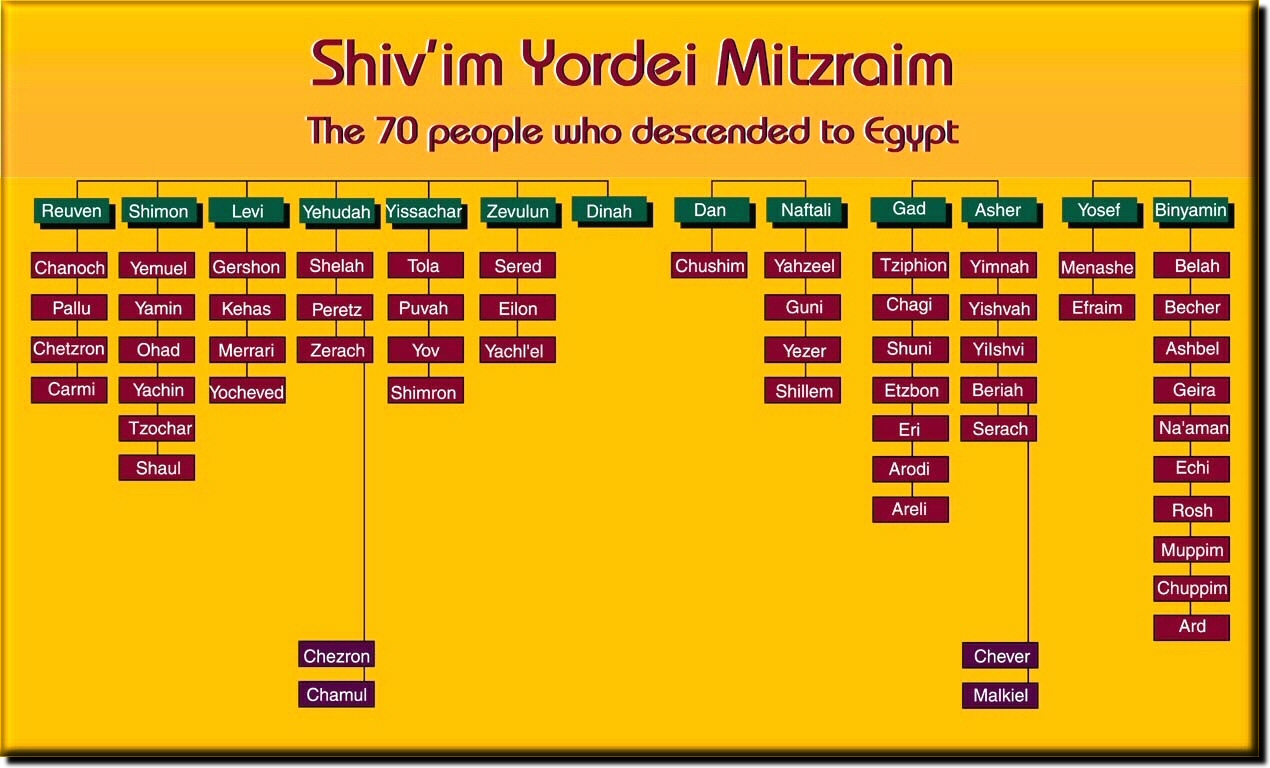
[NOTE: The Masoretic Text has "seventy" souls. This appears to be an
obvious alteration to make the Torah align more with kabbalistic
gemetria but still more, to disgree with the New Testament testimony of
Stephen before the Sanhedrin: "Then sent Joseph, and called his father
Jacob to him, and all his kindred, seventy-five souls" (Acts 7:14)
The Dead Sea Scrolls (4Q Exod-a) also agrees with the LXX in this place
that "seventy-five" souls, not "seventy" (as the rabbis have it) came
down to Mitzrayim.]
#Shifrah (more commonly spelled "Shifra") was one of the two Ivirim midwives (Shifrah and Pu'ah) who delivered the children of the Yisraelites during the Mitzrayim servitude.
According to one Rabbinic position, Shifrah and Pu'ah were mother and daughter: Yocheved and Miriyam; and according to another view, daughter-in-law, and mother-in-law: Yocheved and Elisheva Bat Aminadav. In both identifications, these are prominent Ivirim women who were celebrated for their righteousness.
However, according to one unique tradition, Shifrah and Pu'ah were goyim midwives, who were said to be pious women and true converts (Midrash Tadshe, Ozar ha-Midrashim Eisenstein, page 474). This tradition would read the phrase “the Hebrew midwives” as “the midwives of the Hebrew women.”
Pithom פּתם/ Πειθώ 비돔 the city of justice (Pi-Tum or Pa-Tum; modern day Tell el-Retaba), means "house of Tum" [or "Atum,"], i.e., the sun-god of Heliopolis; and the Greek word "Hero" is probably a translation of "Atum."one of the store-cities which the Pharaoh made the Israelites build. (See Map of Wilderness Journey - Korea language)
Ra'amses" (Hebrew: רַעְמְסֵס) is mentioned in the Scripture four times: in Genesis 47:11; Exodus 1:11 and Numbers 33:3,5. Ra'amses was the point from which the Israelites departed during their exodus from Mitzrayim.
#Goshen :- the land of Goshen אֶרֶץ גֹּשֶׁן where Yosef and his descendants settled. The Land of Goshen for every shepherd is an abomination to the Mitzrayim. (Beresheet 46:34) (Hebrew גֹּשֶׁן, Standard Hebrew Góšen, Tiberian Hebrew #Gōšen) It is the region around the city with the modern name Fakus in the eastern Nile delta in Mitzrayim referenced in the Biblical story of Yosef. In the Septuagint it is called Gesan, by Artapanus called Kessan, from Mitzrayim Gesem. Mitzrayimian word qas, meaning "inundated land" because Goshen was apparently the same region.
The name Goshen as connected to the verb NaGaSh (נִגַּשׁ), to draw near, approach come near; to approach one another; bring near. The Torah portion (Beresheet 44:18—47:27) in which Goshen is first mentioned is known by its first Hebrew word, vaYi(n)gash, וַיִּגַּשׁ , "Then Yehudah approached (Yosef)...
Beresheet 47:6 Goshen The Hebrew word for Goshen, "גֹּשֶׁן" (Goshen), is commonly translated as "drawing near". Goshen is called "the best part" of the land of Mitzrayim because it was fertile land, suitable for raising livestock. But it is also implied to be somewhat set apart from the rest of Mizrayim, because Yosef tells his family to present themselves to the Paroh as keepers of livestock, "in order that you may settle in the land of Goshen, because all shepherds are abhorrent to the people of Mitzrayim." Beresheet 47:11 interchanges the "land of Ramesses" with Goshen: "Yosef settled his father and his brothers and granted them a holding in the land of Mitzrayim, in the best part of the land, in the land of Ramesses, as Paroh had instructed.
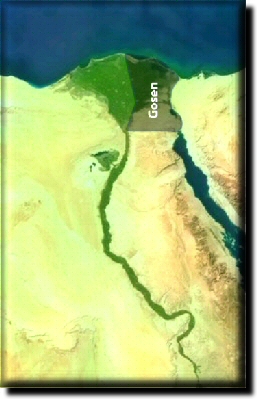
The area is just a few kilometers south of the ancient capital of Avaris (Mitzrayim Hatwaret, where the later city of Pi-Rameses was built), where, from the 12th dynasty of Mitzrayim, a major administrative headquarters was located. It was there that Yosef had his house, and where he was laid to rest.
The Station List :- The Stations list is the list of the locations visited by the Israelites following their exodus from Mitzrayim.
