
Yeshua (ישוע)is Adon over the Yom Shabbat 12:1-8
(Mark 2:23-28; Loukas 6:1-5)
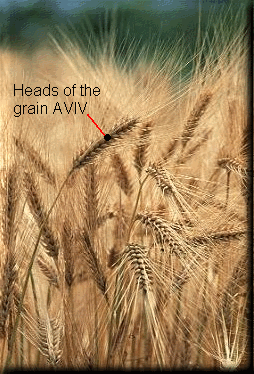
Yeshua (ישוע) was accused of teaching his Talmidim to break the Shabbat in Rabbinic known asrmvev lq (kal vachomer)
12:1 At that time Yeshua (ישוע) went on Shabbat through the corn; and his Talmidim were an hungry, and began to pluck theheads of the grain (Aviv), and to eat.
12:2 But when the Perushim saw [it], they said to him, Hinei, Thy Talmidim do that which is not mutar (permissible) to do upon Shabbat.
12:3 But He said to them: "Have ye not read what Dawid did, when he was an hungry, and they that were with him;
12:4 How he entered into the Beit Elohim (אלהים), and did eat the Lechem HaPanim (the Bread of the Presence), which was not mutar (permissible) for him to eat, neither for them which were with him, but only for the Kohenim?"
12:5 Or have ye not read in the Torah, how that on Shabbat the Kohenim in the Beit HaMikdash profane the Shabbat, and are blameless?
12:6 But I say to you, That in this place is [one] greater than the Beit HaMikdash.
12:7 But if you had known what [this] means, I will have mercy, and not sacrifice (Hoshea 6:6), you would not have condemned the guiltless.(Micah 6:6-8, Matt 9:13)
12:8 For ha BEN ADAM is Adon even of the Shabbat.
Yeshua (ישוע)Heals a man with a withered hand 12:9-14 (Mark 3:1-6; Loukas 6:6-11)
12:9 And when he was departed thence, he went into their Shul (synagogue):
12:10 And, Hinei, there was a man which had [his] hand withered. And they asked him, saying, Is it mutar (permissible) to heal on Shabbat? that they might accuse him.
12:11 And he said to them, What man shall there be among you, that shall have one sheep, and if it fall into a pit on Shabbat, will he not lay hold on it, and lift [it] out?
12:12 How much then is a man better than a sheep? Wherefore it is mutar (permissible) to do well on Shabbat.
12:13 Then said he to the man, Stretch forth thine hand. And he stretched [it] forth; and it was restored whole, like as the other.
12:14 Then the Perushim went out, and held a council against him, how they might destroy him.
12:15 But when Yeshua (ישוע) knew [it], He withdrew Himself from thence: and great multitudes followed Him, and He healed them all;
12:16 And charged them that they should not make him known:
12:17 That it might be fulfilled which was spoken by YeshaYahu ha Navi, saying,
12:18 hinei My Eved, whom I have chosen; My beloved, in whom my soul is well pleased: I will put My ruach upon him, and he shall shew mishpatim to the Goyim.
12:19 He shall not strive, nor cry; neither shall any man shema his voice in the streets.
12:20 A bruised reed shall he not break, and smoking flax shall he not quench, till he send forth mishpatim to victory.
12:21 And IN His NAME shall the Goyim trust.
The Power of Elohim (אלהים) over the shedim (devil)
(Mark 3:20-30; Loukas 11:14-23)
12:22 Then was brought to him one possessed with a shedim, blind, and dumb: and he healed him, insomuch that the blind and dumb both spake and saw.
12:23 And all the people were amazed, and said, Is not this the son of Dawid?
12:24 But when the Perushim heard [it], they said, This [fellow] doth not cast out devils, but by Ba'al-Zibbul the sar ha shadim (the Prince of Demons).
12:25 And Yeshua (ישוע) knew their thoughts, and said to them, every malkut divided against itself is brought to desolation; and every city or bayit divided against itself shall not stand:
12:26 And if satan cast out satan, he is divided against himself; how shall then his malkut stand?
12:27 And if I by Ba'al-Zibbul cast out shadim (devils), by whom do your children cast [them] out? therefore they shall be your shoftim.
12:28 But if I cast out shadim (devils) by the Ruach of Elohim (אלהים), then the Malkut of Elohim (אלהים) is come to you.
12:29 Or else how can one enter into a strong man's bayit, and spoil his goods, except He (Yeshua (ישוע)) first bind the strong man? and then He will spoil his bayit.
12:30 He that is not with Me is against Me; and he that gathers not with me scatters abroad.
12:31 Wherefore I say to you, All manner of sin and blasphemy shall be forgiven to men: but the blasphemy [against] the Ruach HaKodesh shall not be forgiven to men.
12:32 And whosoever speaks a word against ha BEN ADAM, it shall be forgiven him: but whosoever speaks against Ruach HaKodesh, it shall not be forgiven him, neither in this world, neither in the [world] to come.
12:33 Either make the tree good, and his fruit good; or else make the tree corrupt, and his fruit corrupt: for the tree is known by [his] fruit.
12:34 *O generation of vipers, how can ye, being evil, speak good things? for out of the abundance of the heart the mouth speaks. *Mt 3:7 ; Lu 3:7
12:35 A good man out of the good treasure of the heart brings forth good things: and an evil man out of the evil treasure brings forth evil things.
12:36 But I say to you, That every lashon hara (evil speech) that men shall speak, they shall give account thereof in the Yom HaDin.
12:37 For by thy words thou shalt be tzadek, and by thy words thou shalt be condemned.
(Mark 8:11-12; Loukas 11:29-32)
12:38 Then certain of the Sofrim and of the Perushim answered, saying, Rabbi, we would see a sign from thee.
12:39 But he answered and said to them, An evil and adulterous generation seeks after a sign; and there shall no sign be given to it, but the sign of Ha Navi Yonah:
12:40 For as Yonah was three days and three nights in the whale's belly; so shall the Son of man be three days and three nights in the heart of the earth.
12:41 The men of Nineveh shall rise in Yom Ha Din with this generation, and shall condemn it: because they repented at the proclaiming of Yonah; and, hinei, a greater than Yonah [is] here.
12:42 The queen of the south shall rise up in the Yom HaDin with this generation, and shall condemn it: for she came from the uttermost parts of the eretz to shema the wisdom of Shlomo; and, hinei, a greater than Shlomo [is] here.
(Loukas 11:24-26; Job 1:7; 1 Kefa 5:8)
12:43 When the ruach tamei is gone out of a man, he walks through dry places, seeking rest, and finds none.
12:44 Then he said, I will return into my bayit from whence I came out; and when he is come, he finds [it] empty, swept, and garnished.
12:45 Then he goes and takes with him seven other spirits more wicked than himself, and they enter and dwell there; and the last state of that man is worse than the first. So shall it also be with this wicked generation."
The True Family of Yeshua (ישוע) 12:46-50
(Mark 3:31-35; Loukas 8:19-21)
12:46 While He yet talked to the people, Hinei, [his] mother and His brethren stood without, desiring to speak with him.
*12:47 Then one said to him, Hinei, Thy mother and Thy brethren stand without, desiring to speak with Thee.
12:48 But he answered and said to him that told him, Who is My mother? and who are My brethren?
12:49 And he stretched forth His hand toward His Talmidim, and said, hinei My mother and My brethren!
12:50 For whosoever shall do the will of My Father which is in shamayim, the same is My brother, and sister, and mother.
**Chap12:47 This verse is not included in some early manuscripts of MattiYahu's goodnews. Hamalomdim think it might have been mistakenly added by some copyists, or included to harmonize the account with Markos.
The translators of the English Standard Version (ESV) have chosen not to include it, though it does appear in the New International Version (NIV) and others.This verse repeats the end of the previous verse in the form of someone giving Yeshua the message that His Emu and Achim were outside wanting to speak to Him. What MattitYahu does not include that Markos's version of this story does is that hamichpeacha (מִשׁפָּחָה) had come to "take charge" of Yeshua. They said,"He is out of his mind" (Mark 3:21). This additional information tells us two things.
First, Yeshua's michpeacha (מִשׁפָּחָה) did not yet believe that He was the Mashiach (or they would not have said He was out of His mind).
Second, they were still concerned about Him and either wanted to help Him or to remove Him from the public eye and further embarrassment. There's no way to know. Once Yeshua is told they are outside waiting for Him, He says a surprising thing about michpeacha (מִשׁפָּחָה) (MattitYahu 12:48).
12:29 the strong man = satan; His house= is the sphere in which he holds sway; His goods are his demons. Yeshua (ישוע) binds the strong man
Perushim A sect that seems to have started after the glot yahodit, recognised in mesoret be'el fa a standard of belief and life.They sought for distinction and praise by outward observance of external rites and by outward forms of piety, and such as rachtzot texiot, tzum, tefilot, and natinat Tzedaka; and, comparatively negligent of genuine piety, they prided themselves on their fancied good works. They held strenuously to a belief in the kiyomo shel haTov and melachim ra'im, and to the expectation of a Mashiach; and they cherished the hope that the dead, after a preliminary experience either of reward or of onish beha'ades, would be recalled to life by him, and be requited each according to his individual deeds. In opposition to the usurped dominion of the Herods and the rule of the Romaios, they stoutly upheld the te'okeratiya and their country cause, and possessed great influence with the common people. According to Yosfus they numbered more than 6000. They were bitter enemies of Yeshua (ישוע) and his cause; and were in turn severely rebuked by him for their avarice, ambition, hollow reliance on outward works, and affection of piety in order to gain popularity.
The Perushim legal nitpickers, charged that the Shabbat had been broken. Though their specific charges are not stated it is likely that they accused the talmidim for the following reasons found in Loukas 6:1 One Shabbat, while Yeshua (ישוע) was passing through some wheat fields, His Talmidim began plucking the roshi tvu'a, rubbing them between their hands and eating the seeds.
cross reference also to Markos Chapter 2:23-28; Loukas 6:1-5
Yeshua (ישוע)is Master of the Shabbat: MattiYahu 12:1 -8; Mark 2:23 - 28; Loukas 6:1 -5 Hebrews 4:1-13 It was Yeshua (ישוע) who had instituted the Torah in the first place, and therefore He was the one most qualified to interpret its true meaning. In vs 12:7 " archam vele akrav" Hashem puts compassion before the ritual. He would rather see His people picking grain on the Shabbat to satisfy their hunger than observing the day so strictly as to inflict physical distress. The Torah of YHWH was never intended to inflicted hardship on His faithful people particular David the one he had chosen.
There are about shloshim vetash'a isurim against work on the shabbat but it was never intended to apply to the service of Hashem, deeds of necessity (12:3,4); or deeds of mercy or compassion (12:11,12). the Shabbat was to prophectic significant of those who enter rest in Mashiach. To learn more about shabbat visit this site Click here : Understand the spiritual significant of Shabbat
Man represent Yisrael as nation
Unclean spirit represent the idolatry
A house empty speaks of spiritual vacuum, a dangerous condition. Also those who consider as free thinker might be a target of the adversary.
31- 34 Blasheming the Ruach HaKodesh
1. wilfully continuing to deny the goodnews offered when the Ruach HaKodesh has made clear conviction to you that it is true.
2. attributing or calling the works of the Ruach HaKodesh to the adversary.
48-50 Adonai Yeshua (ישוע)consider one who believe in him, identify his suffering, walk with him, those are consider the spiritual family ties which supersede than phyiscal blood relationship. We learn that eventually his relatives became members of His spiritual family as well (Acts 1:14, Galatian 1:19)