
Chananyah and Safira lie to the Ruach HaKodesh
5:1 But a certain man named ChananYah (חֲנַנְּיָּה), with Sapirah (שַׁפִּׁירָּה) his wife, sold a possession,
5:2 And kept back [part] of the price, his wife also being privy [to it], and brought a certain part, and laid [it] at the shlichim' feet.
5:3 But Kefa (פטרוס) said, Chananyah, why hath satan filled thine heart to lie to the Ruach HaKodesh, and to keep back [part] of the price of the land?
5:4 Whiles it remained, was it not thine own? and after it was sold, was it not in thine own power? why hast thou conceived this thing in thine heart? thou hast not lied unto men, but unto Elohim (אלהים).
5:5 And Chananyah hearing these words fell down, and gave up the ruach: and great fear came on all them that heard these things.
5:6 And the young men arose, wound him up, and carried [him] out, and buried [him].
5:7 And it was about the space of three hours after, when his wife, not knowing what was done, came in.
5:8 And Kefa (פטרוס) answered unto her, Tell me whether ye sold the land for so much? And she said, Yea, for so much.
5:9 Then Kefa (פטרוס) said unto her, How is it that ye have agreed together to tempt the Ruach of ADONAI (יהוה)? Hinnei, the feet of them which have buried thy husband [are] at the door, and shall carry thee out.
5:10 Then fell she down straightway at his feet, and yielded up the ruach: and the young men came in, and found her dead, and, carrying [her] forth, buried [her] by her husband.
5:11 And great fear came upon all the assembly, and upon as many as heard these things.
5:12 And by the hands of the shlichim were many signs and wonders wrought among the people; (and they were all with one accord in Shlomo's porch.
5:13 And of the rest durst no man join himself to them: but the people magnified them.
5:14 And believers were the more added to ADONAI (יהוה), multitudes both of men and women.)
5:15 Insomuch that they brought forth the sick into the streets, and laid [them] on beds and couches, that at the least the shadow of Kefa (פטרוס) passing by might overshadow some of them.
5:16 There came also a multitude [out] of the cities round about unto Yerushalayim, bringing sick folks, and them which were vexed with unclean spirits: and they were healed every one.
5:17 Then the Kohen HaGadol rose up, and all they that were with him, (which is the sect of the Tz'dukim,) and were filled with indignation,
5:18 And laid their hands on the shlichim, and put them in the common prison.
5:19 But the messenger of ADONAI (יהוה) by night opened the prison doors, and brought them forth, and said,
5:20 Go, stand and speak in HaMikdash to the people all the words of this chayim.
5:21 And when they heard [that], they entered into HaMikdash early in the morning, and taught. But the Kohen HaGadol came, and they that were with him, and called the Sanhedrin together, and all the senate of the children of Yisrael, and sent to the prison to have them brought.
5:22 But when the officers came, and found them not in the prison, they returned, and told,
5:23 Saying, The prison truly found we shut with all safety, and the keepers standing without before the doors: but when we had opened, we found no man within.
5:24 Now when the Kohen HaGadol and the captain of HaMikdash and the chief Kohenim heard these things, they doubted of them whereunto this would grow.
5:25 Then came one and told them, saying, Hinnei, the men whom ye put in prison are standing in HaMikdash, and teaching the people.
5:26 Then went the captain with the officers, and brought them without violence: for they feared the people, lest they should have been stoned.
5:27 And when they had brought them, they set [them] before the Sanhedrin: and the Kohen HaGadol asked them,
5:28 Saying, Did not we strictly command you that ye should not teach in this Name? and, Hinnei, ye have filled Yerushalayim with your teachings (didache), and intend to bring this man's blood upon us.
5:29 Then Kefa (פטרוס) and the [other] shlichim answered and said, We ought to obey Elohim (אלהים) rather than men.
5:30 The Elohim (אלהים) Aveniu raised up Yeshua (ישוע), whom ye slew and hanged on a tree.
5:31 Him hath Elohim (אלהים) exalted with his right hand [to be] a SAR and a Moshiach, for to give teshuvah to Yisrael, and forgiveness of sins.
5:32 And we are his witnesses of these things; and [so is] also the Ruach HaKodesh, whom Elohim (אלהים) hath given to them that obey him.
5:33 When they heard [that], they were cut [to the heart], and took counsel to slay them.
5:34 Then someone in the Sanhedrin stood up, a Parush, named Rabban Gamli-el (גמליאל), a moreh ha Torah, respected among all the people of Yisrael, and he orders to put the shlichim outside for a little while.
5:35 And said unto them, Ye men of Yisrael, take heed to yourselves what ye intend to do as touching these men.
5:36 For before these days rose up Theudas (the gift of Elohim) , boasting himself to be somebody; to whom a number of men, about four hundred, joined themselves: who was slain; and all, as many as obeyed him, were scattered, and brought to nought.
5:37 After this man rose up Yehudah of Galil in the days of the taxing, and drew away much people after him: he also perished; and all, [even] as many as obeyed him, were dispersed.
5:38 And now I say unto you, Refrain from these men, and let them alone: for if this counsel or this work be of men, it will come to nought:
5:39 But if it be of Elohim (אלהים), ye cannot overthrow it; lest haply ye be found even to fight against Elohim (אלהים).
5:40 And to him they agreed: and when they had called the shlichim, and beaten [them], they commanded that they should not speak in the Name of Yeshua (ישוע), and let them go.
5:41 And they departed from the presence of the Sanhedrin, rejoicing that they were counted worthy to suffer shame for His Name.
5:42 And daily in HaMikdash, and in every house, they ceased not to teach and proclaim Yeshua (ישוע) Ha Moshiach.
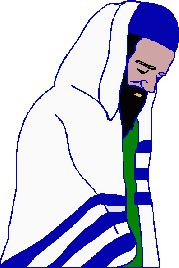 Gamaliel the Elder (גּמליאל,
gamlī'ēl, “reward or recompense of Elohim”;
Γαμαλιήλ, Gamaliḗl):, or Rabbi Gamaliel I, was a leading authority in the Sanhedrin in the mid first century. He was the grandson of the great Jewish teacher Hillel the Elder, and died twenty years before the destruction of the second temple in Jerusalem. He fathered a son, whom he called Simeon, after his father's name[1], and a daughter, whose daughter (i.e., Gamaliel's granddaughter) married a priest named Simon ben Nathanael[2]. The name Gamaliel is the Greek form of the Hebrew name meaning reward of Hashem.
Gamaliel the Elder (גּמליאל,
gamlī'ēl, “reward or recompense of Elohim”;
Γαμαλιήλ, Gamaliḗl):, or Rabbi Gamaliel I, was a leading authority in the Sanhedrin in the mid first century. He was the grandson of the great Jewish teacher Hillel the Elder, and died twenty years before the destruction of the second temple in Jerusalem. He fathered a son, whom he called Simeon, after his father's name[1], and a daughter, whose daughter (i.e., Gamaliel's granddaughter) married a priest named Simon ben Nathanael[2]. The name Gamaliel is the Greek form of the Hebrew name meaning reward of Hashem.
A Pharisee who at the meeting of the “council” succeeded in persuading its members to adopt a more reasonable course when they were incensed at the doctrine of Kefa and the rest of the apostles and sought to slay them (Act_5:33-40). That he was well qualified for this task is attested by the fact that he was himself a member of the Sanhedrin, a teacher of the Torah, and held in high honor among all the people. In his speech he pointed out to his fellow-councilors the dire consequences that might ensue upon any precipitous action on their part. While quoting instances, familiar to his hearers, of past insurrections or seditions that had failed, he reminded them at the same time that if this last under Kefa “is of Elohim, ye will not be able to overthrow them; lest haply ye be found even to be fighting against Elohim.” As a result of his arguments, the apostles, after being beaten and admonished to speak no longer in the name of Yeshua, were released. In the speech which he was permitted by Lysias to deliver from the stairs of the palace after the riot in Jerushalayim, Paulos referred to Gamaliel as the teacher of his youth, who instructed him rigidly in the Mosaic law (Act_22:3).
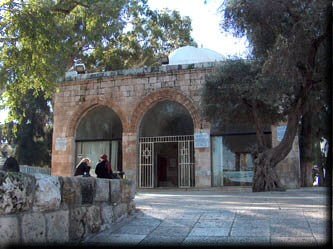 Structure of the 13th century tomb in
the heart of the city built attributed Gamaliel