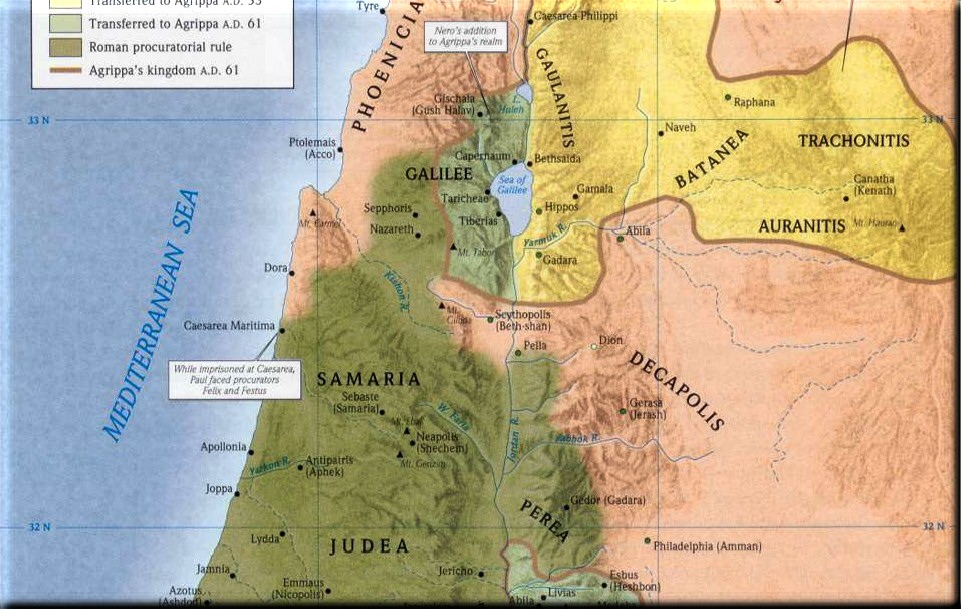
25:1 Now when Phestos was come into the province, after three days he ascended from Kaisareia to Yerushalayim.
25:2 Then the Kohen HaGadol and the chief of the Yehudim informed him against Paulos, and besought him,
25:3 And desired favour against him, that he would send for him to Yerushalayim, laying wait in the way to kill him.
25:4 But Phestos answered, that Paulos should be kept at Kaisareia, and that he himself would depart shortly [thither].
25:5 Let them therefore, said he, which among you are able, go down with [me], and accuse this man, if there be any wickedness in him.
25:6 And when he had tarried among them more than ten days, he went down unto Kaisareia; and the next day sitting on the mishpat seat commanded Paulos to be brought.
25:7 And when he was come, the Yehudim which came down from Yerushalayim stood round about, and laid many and grievous complaints against Paulos, which they could not prove.
25:8 While he answered for himself, Neither against Ha Torah of the Yehudim, neither against Beit HaMikdash, nor yet against Kaisar, have I offended any thing at all.
25:9 But Phestos, willing to do the Yehudim a pleasure, answered Paulos, and said, Wilt thou go up to Yerushalayim, and there be judged of these things before me?
25:10 Then said Paulos, I stand at Kaisar's mishpat seat, where I ought to be judged: to the Yehudim have I done no wrong, as thou very well knowest.
25:11 For if I be an offender, or have committed any thing worthy of death, I refuse not to die: but if there be none of these things whereof these accuse me, no man may deliver me unto them. I appeal unto Kaisar.
25:12 Then Phestos, when he had conferred with the Sanhedrin, answered, Hast thou appealed unto Kaisar? unto Kaisar shalt thou go.
25:13 And after certain days king Agrippas and Bernice came unto Kaisareia to salute Phestos.
25:14 And when they had been there many days, Phestos declared Paulos's cause unto the king, saying, There is a certain man left in bonds by Phelix:
25:15 About whom, when I was at Yerushalayim, the chief Kohanim and the Zekenim (Elders) of the Yehudim informed [me], desiring [to have] mishpat against him.
25:16 To whom I answered, It is not the manner of the Romans to deliver any man to die, before that he which is accused have the accusers face to face, and have licence to answer for himself concerning the crime laid against him.
25:17 Therefore, when they were come hither, without any delay on the morrow I sat on the judgment seat, and commanded the man to be brought forth.
25:18 Against whom when the accusers stood up, they brought none accusation of such things as I supposed:
25:19 But had certain questions against him of their own superstition, and of one Yeshua, which was dead, whom Paulos affirmed to be alive.
25:20 And because I doubted of such manner of questions, I asked [him] whether he would go to Yerushalayim, and there be judged of these matters.
25:21 But when Paulos had appealed to be reserved unto the hearing of Sebastos (Augustus), I commanded him to be kept till I might send him to Kaisar.
25:22 Then Agrippas said unto Phestos, I would also hear the man myself. To morrow, said he, thou shalt hear him.
25:23 And on the morrow, when Agrippas was come, and Bernice, with great pomp, and was entered into the place of hearing, with the chief captains, and principal men of the city, at Phestos' commandment Paulos was brought forth.
25:24 And Phestos said, King Agrippas, and all men which are here present with us, ye see this man, about whom all the multitude of the Yehudim have dealt with me, both at Yerushalayim, and [also] here, crying that he ought not to live any longer.
25:25 But when I found that he had committed nothing worthy of death, and that he himself hath appealed to Sebastos (Augustus), I have determined to send him.
25:26 Of whom I have no certain thing to write unto my lord. Wherefore I have brought him forth before you, and specially before thee, O king Agrippas, that, after examination had, I might have somewhat to write.
25:27 For it seemeth to me unreasonable to send a prisoner, and not withal to signify the crimes [laid] against him.
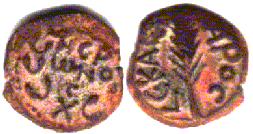
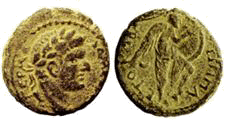
Porcius Phestos (Porkios Phestos) was procurator of Yehudah from about AD 58 to 62, succeeding Antonius Phelix. His exact time in office is not known. He inherited all of the problems of his predecessor in regard to the Roman practice of creating civic privileges for Jews. Only one other issue bedeviled his administration, the controversy between Agrippas II and the kohenim in Yerushalayim regarding the wall erected at the temple to break the view of the new wing of Agrippas's palace.
During his administration, Jewish hostility to Rome was greatly inflamed by the civic privileges issue. Feelings were aroused which played an important part in the closely following Jewish War of AD 66.
It was before Phestos that Paulos had his final hearing. Phestos sought to induce Paulos to go to Yerushalayim for trial; Paul appealed to the Emperor. The appeal resulted in Paulos being deported to Rome in the autumn of AD 58 (Acts 25-26).

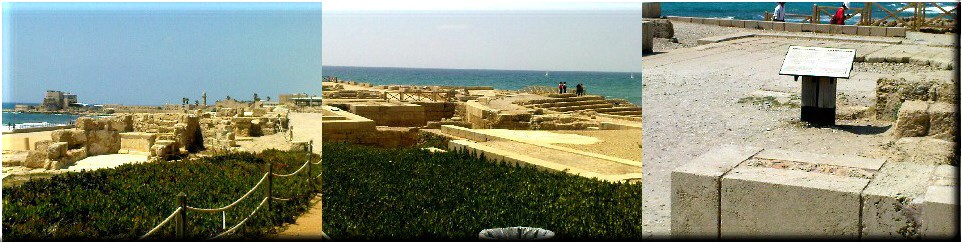
On June 16 2008, I arrived with the tour group at Kaisara and read the display information (third picture) as follows:-
In 58 AD the Apostle Paulos, accused of having caused a riot was sent to Kaisara to be tried by the governor. Being a Roman Citizen, Paulos demanded to be heard at the Emperor's court. He sailed to Rome from Kaisara's harbour. There he was tried and a few years later executed. This picture above remaining remnant of the hall may well be the "Place of hearing" mentioned in the Acts of Apostles.
King Agrippas The last ruler of the Herodian line - Agrippa II - reigned for an impressive 43 years (50-96 CE). His originally named Marcus Julius Agrippa, was the seventh and last king of the family of Herod the Great, thus last of the Herodians. He was the brother of Berenice and Drusilla (second wife of the Roman procurator Antonius Felix). He is sometimes also called Herod Agrippa II.[1] Coins issued by Agrippa II include both Jewish and pagan types.