The Synagogue Strategy (Acts 17:1-9)
Paulos follows his standard, covenantally rooted pattern, Gospel did not replace Judaism
Maaseh-shlichim 17 Messianic Jewish Perspective
17:1 וַיְהִי אַחֲרֵי נָסְעָם בְּאַמְפִפּוֹלִיס וּבְאַפֹּלוֹנְיָא בָּאוּ אֶל־תַּסְלוֹנִיקִי וְשָׁם בֵּית־כְּנֵסֶת לַיְּהוּדִים׃
Vayhi acharei nase'am be'Amfipolis uve'Apoloneya ba'u el-Tasloniki vesham Beit-Keneset laYehudim.
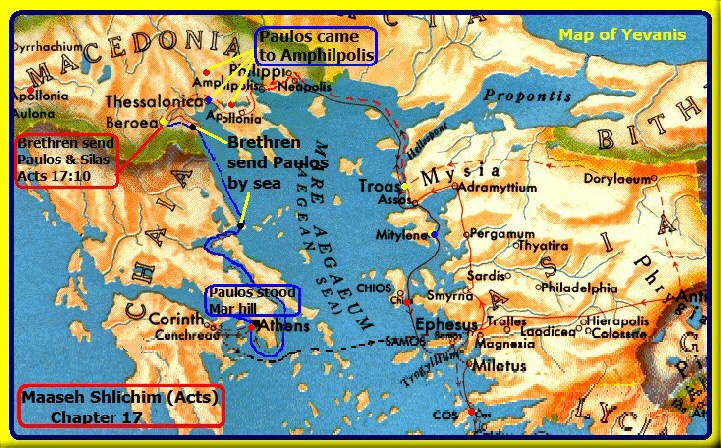
And having passed through Amphipolis and Apollonia, they came to Thessalonike, where there was a house of Keneset Yehudim:
17:2 וּפוֹלוֹס כַּאֲשֶׁר הִסְכִּין בָּא אֲלֵיהֶם וַיִּתְוַכַּח עִמָּהֶם בְּהָבֵן בַּמִּקְרָא שְׁלֹשֶׁת יְמֵי שַׁבָּתוֹת׃
UPolos ka'asher hiskin ba aleihem vayitvakach immahem behaven bamikra sheloshet yemei shabbatot.
And according to his practice, Paulos join in their minyan, on shloshah Shabbatot he gave them drashot from the Kitvei HaKodesh, (scriptures; graphe),
17:3 Explaining and making Messianic midrash and pashat that Mashiach had to suffer and rise again from the dead, and saying:
"...This Yeshua (ישוע), whom I proclaim unto you, is Mashiach."
17:4 And some of them were persuaded and were joined with Paulos and Silas, and of the Yirei Elohim Yevanis a great multitude, and of the chief women not a few.
17:5 But the Yehudim which believed not, moved with envy, took unto them certain lewd fellows of the baser sort, and gathered a company, and set all the city on an uproar, and assaulted the house of Iason, and sought to bring them out to the people.
17:6 And when they found them not, they drew Iason and certain brethren unto the rulers of the city, crying, These that have turned the world upside down are come hither also;
17:7 Whom Iason has received: and these all do contrary to the decrees of Kaisar, saying that there is another king, [one] Yeshua (ישוע).
17:8 And they troubled the people and the rulers of the city, when they heard these things.
17:9 And when they had taken security of Iason, and of the other, they let them go.
The Berean Model of Torah Study (Acts 17:10-15)
17:10 And the brethren immediately sent away Paulos and Silas by night unto Beroia: who coming [thither] went into the house of Keneset Yehudim.
17:11 These (Berean Yehudim) were more noble than those in Thessalonike, in that they received the Davar Elohim with all readiness of mind, and searched the Kivrei ha Kodesh (scriptures, graphe) daily, whether those things were so.
17:12 Many of them therefore believed, with not a few Greek women of high standing as well as men.
17:13 But when the Yehudim of Thessalonike had knowledge that the Devarim Elohim (אלהים) was proclaimed of Paulos at Beroia, they came thither also, and stirred up the people.
17:14 And then immediately the brethren sent away Paulos to go as it were to the sea: but Silas and Timotheos remained there.
17:15 And they that conducted Paulos brought him unto Athenai: and receiving a commandment unto Silas and Timotheos for to come to him with all speed, they departed.
The Areopagus: Translating God to the Nations (Acts 17:16-34)
17:16 Now while Paulos waited for them at Athenai, his spirit was provoked within him as he was observing the city full of idols.
17:17 Therefore Paulos was dialoguing and arguing in the synagogue with the Jews and with the God-fearing Gentiles and also in the marketplace everyday with those who happened to be there.
17:18 Also some of the Epikoureios, and of the Stoikos philosophers were conversing with him, some were saying:
"What's this babbler trying to say? while others, "He seems to be a preacher of foreign divinities (daimonion): because he preaching unto them Iēsous (ישוע), and the resurrection."
17:19 And they took Paulos, to Areios Pagos, saying:
"May we know what this new teaching,
is that you are talking about?"
17:20 For you are bring some strange things to our ears
"we want to know what these things mean?"
17:21 (For all the Athenians and strangers which were there spent their time in nothing else, but either to tell, or to hear some new thing.)
the Name of Hashem use as "Theos and Kurio (Adonay) speaking to Greek Goy
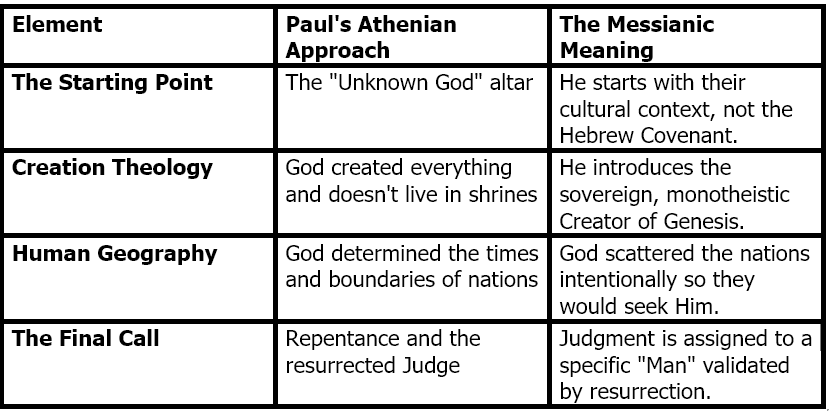
17:22 So Paulos stood in the midst of the Areios Pagos and said, "Men of Athens, I observe that you are very religious in all respects.
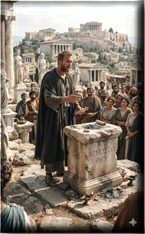
17:23 For as I was passing through and considering the objects of your worship I even found an altar with this inscription:
"agnostos
(unknown) THEOS (G_D)".
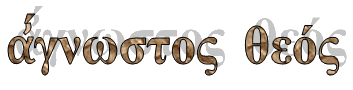
Therefore, One you worship without knowing Him I proclaim to you.
17:24 Theos that made the world and all things therein, seeing that He is Master of heaven and earth, dwells not in temples made with hands;
17:25 Neither is worshipped with men's hands, as though he needed any thing, seeing He gives to all life, and breath, and all things;
17:26 and He made from one man every nation of mankind to live on all the face of the earth, having determined their appointed times and the boundaries of their habitation,
17:27 That they should zeteo (seek, worship) Kurios (Master of Creator), if perhaps they might pselaphao (feel, touch, grope, personal relationship) after Him, and heurisko (find) Him, though He be not far from every one of us: Devarim 4:7; Isa 55:6; Jer 23:23,24
17:28 For in Him we live, and move, and have our being; as certain also of your own poets have said, For we are also his offspring.
17:29 "Being then the children of God, we ought not to think that the Divine Nature is like gold or silver or stone, an image formed by the art and thought of man.
17:30 "Therefore having overlooked the times of ignorance, God is now declaring to men that all people everywhere should repent,
17:31 Because He has appointed a day, in the which he will judge the world in righteousness by [that] man whom He has ordained; [whereof] He has given assurance unto all [men], in that He has raised him from the dead.
17:32 And when they heard of the resurrection of the dead, some mocked: and others said, We will hear you again of this [matter].
17:33 So Paulos departed from among them.
17:34 However certain men clave unto him, and believed: among the which [was] Dionusios the Areopagites, and a woman named Damaris, and others with them.
GODHEAD - ELHUTA - in Aramaic θεῖος - theios godlike (neuter as noun, divinity): - divine, godhead. Hashem's essence, Divine Nature
Epikoúreios and Stoïkós Philosophers were those who followed the teachings of Epicurus (Greek Έπίκουρος) (341 BC, Samos – 270 BC, Athens) the purpose of philosophy was to attain the happy, tranquil life, characterized by the absence of pain and fear, and by living a self-sufficient life surrounded by friends. He taught that pleasure and pain are the measures of what is good and bad, that death is the end of the body and the soul and should therefore not be feared, that the gods do not reward or punish humans, that the universe is infinite and eternal, and that events in the world are ultimately based on the motions and interactions of atoms moving in empty space.
Stoïkós - were followers of Zeno, they got their name from the Greek word stoa meaning porch for Zeno taught at a place in Athens called stoa
|
[EPICUREANS] |
[RAV SHA'UL / PAUL] |
[STOICS] |
|
Deists: God is distant/absent. --> |
"He is not far from each of us. |
Pantheists: Everything is god. |
|
Materialists: Random atoms. |
"He made the world and all in it." |
Fatalists: Blind cosmic fate. |
|
Goal: Avoid pain, seek peace. |
"Commanding all people to repent." |
Goal: Self-sufficiency, logic. |
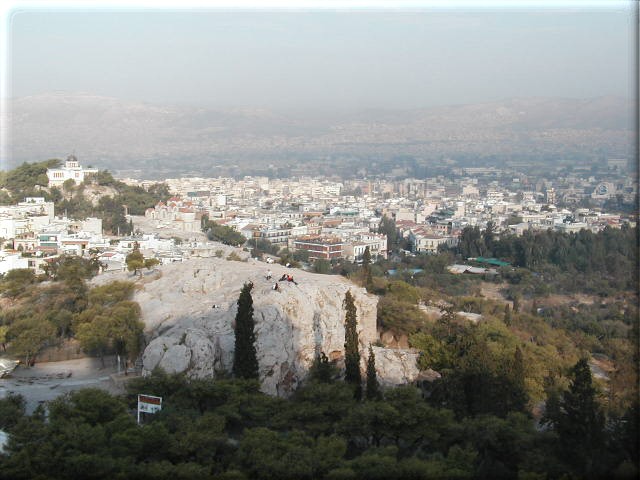
The Areopagus or Areios Pagos (Greek Ἄρειος Πᾶγος) is the 'Hill of Ares', north-west of the Acropolis, which in classical times functioned as the chief homicide court of Athenai. Ares was supposed to have been tried here by the Gods for the murder of Poseidon's son Alirrothios (a typical example of an aetiological myth). In The Eumenides of Aeschylus (458), the Areopagus is the site of the trial of Orestes for killing his mother (Clytemnestra) and her lover (Aegisthus).
The origin of its name is not clear. In Greek pagos means big piece of rock. Areios could have come from Ares or from the Erinyes, as on its foot was erected a temple dedicated to the Erinyes where murderers used to find shelter so as not to face the consequences of their actions.
Near the Areopagus was also constructed the basilica of Dionysius Areopagites.
In pre-classical times (before the 5th century BC), the Areopagus was the council of elders of the city, similar to the Roman Senate. Like the Senate, its membership was restricted to those who had held high public office, in this case that of Archon. In 462 BC, Ephialtes put through reforms which deprived the Areopagus of almost all its functions except that of a murder tribunal in favor of Heliaia.
The Areopagus, like most city-state institutions, continued to function in Roman times, and it was at that location that the Apostle Paulosos delivered the famous 'What therefore you worship as unknown, this I proclaim to you' speech, after seeing an altar 'to the Unknown God'.
The term "Areopagus" also refers to the judicial body of aristocratic origin, the power of which was enhanced by Solon, or the higher court of Greece.
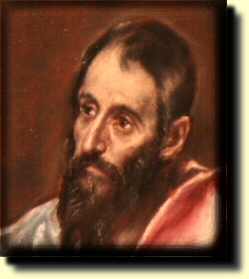 Thessaloniki was founded in 315 BCE by General Kassandros who married the halfsister of Alexander the Great, of the same name, daughter of King Fillip the 2nd of the Macedonian Kingdom. Thessaloniki became part of the Roman Empire in 168 BCE. It is conjectured that the first Jews to arrive in the city were from Alexandria circa 140 BCE. During those ancient times the appeal of Hellenism was strong: Jews inhabiting Thessaloniki and surrounding regions incorporated Greek into their religious ceremonies and were known as Romaniotes.
Saul of Tarsus, or Apostle Paulos the founder of Christianity, preached for 3 consecutive Shabbats at the Ets Ahaim synagogue to native Jews in Thessaloniki in 50 CE. He wasn’t very convincing: the crowd showed feelings of hostility, and he had to be spirited away towards the city of Veria.
Thessaloniki was founded in 315 BCE by General Kassandros who married the halfsister of Alexander the Great, of the same name, daughter of King Fillip the 2nd of the Macedonian Kingdom. Thessaloniki became part of the Roman Empire in 168 BCE. It is conjectured that the first Jews to arrive in the city were from Alexandria circa 140 BCE. During those ancient times the appeal of Hellenism was strong: Jews inhabiting Thessaloniki and surrounding regions incorporated Greek into their religious ceremonies and were known as Romaniotes.
Saul of Tarsus, or Apostle Paulos the founder of Christianity, preached for 3 consecutive Shabbats at the Ets Ahaim synagogue to native Jews in Thessaloniki in 50 CE. He wasn’t very convincing: the crowd showed feelings of hostility, and he had to be spirited away towards the city of Veria.