
10:1 Now the P'lishtim fought against Yisra'el; and the men of Yisra'el fled from before the P'lishtim, and f'ell down slain in mount Gilboa.
10:2 And the P'lishtim followed hard after Shaul, and after his banim; and the P'lishtim slew Yonatan, and Avinadav, and Malkishua, the benai Shaul.
10:3 And the battle went sore against Shaul, and the arkers hit him, and he was wounded of the arkers.
10:4 Then said Shaul to his armour-bearer, Draw thy sword, and thrust me through therewith; lest these uncircumcised come and abuse me. But his armour-bearer would not; for he was sore afraid. So Shaul took a sword, and fell upon it.
10:5 And when his armour-bearer saw that Shaul was dead, he fell likewise on the sword, and died.
10:6 So Shaul died, and his three banim, and all his bayit died together.
10:7 And when all the men of Yisra'el that [were] in the valley saw that they fled, and that Shaul and his banim were dead, then they forsook their cities, and fled: and the P'lishtim came and dwelt in them.
10:8 And it came to pass on the morrow, when the P'lishtim came to strip the slain, that they found Shaul and his banim fallen in mount Gilboa.
10:9 And when they had stripped him, they took his head, and his armour, and sent into the eretz the P'lishtim round about, to carry tidings unto their idols, and to the people.
10:10 And they put his armour in the bayit of their gods, and fastened his head in the temple of Dagon.
10:11 And when all Yavesh-Gil'ad heard all that the P'lishtim had done to Shaul,
10:12 They arose, all the valiant men, and took away the body of Shaul, and the bodies of his banim, and brought them to Yabesh, and buried their bones under the oak in Yavesh, and fasted seven days.
10:13 So Shaul died for his transgression which he committed against YHWH (יהוה), [even] against the Dvar YHWH (יהוה), which he kept not, and also for asking [couns'el] of [one that had] a familiar spirit, to enquire [of it];
10:14 And enquired not of YHWH (יהוה): therefore he slew him, and turned ha malukut unto Davyid Ben Yishai.
If the Plishtim are to be identified as one of the "Sea Peoples", in our Malay language we call them "Orang Laut tahan Barat". then their occupation of Kenaan would have to have taken place during the reign of Ramesses III of the Twentieth Dynasty, ca. 1180 to 1150 BC. Their maritime knowledge presumably would have made them important to the Phoenicians. the Philistines are not autochthonous to the regions of Israel/Palestine which the Bible describes them inhabiting. The Bible contains roughly 250 references to the Philistines or Philistia, and repeatedly refers to them as "uncircumcised", unlike the Semitic peoples, such as Canaanites, which the Bible relates encountered the Israelites following the Exodus. (See, e.g., 1 Samuel 17:26, 17:36; 2 Samuel 1:20; Judges 14:3).
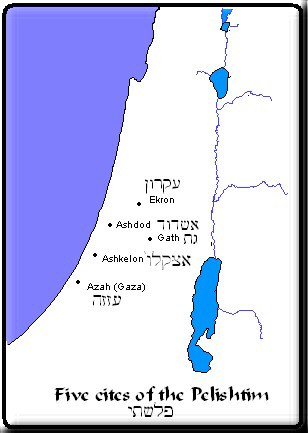
The Plishtim occupied the five cities of Gaza, Ashkelon, Ashdod, Ekron, and Gath, along the coastal strip of southwestern Kenaan, that belonged to Mitzrayim up to the closing days of the Nineteenth Dynasty (ended 1185 BC). The biblical stories of Samson, Shemuel, Shaul and Davyid include accounts of Philistine-Yisra'elite conflicts. The Plishtim long held a monopoly on iron smithing (a skill they possibly acquired during conquests in Anatolia), and the biblical description of Goliath's armor is consistent with this iron-smithing technology.
This powerful association of tribes made frequent incursions against the Hebrews. There was almost perpetual war between the two peoples. They sometimes held the Hebrews, especially the southern tribes, in servitude; at other times they were defeated with great slaughter. According to the Scripture, the Plishtim cities were ruled by seranim (סְרָנִים, "lords"), who acted together for the common good, though to what extent they had a sense of a "nation" is not clear without literary sources. After their defeat by the Hebrew king Davyid, who originally for a time worked as a mercenary for Achish of Gat, kings replaced the seranim, governing from various cities. Some of these kings were called Avimelekh.
The Plishtim lost their independence to Tiglath-Pileser III of Assyria by 732 BC, and revolts in following years were all crushed. Later, Nevukhadretztzar II of Bavel eventually conquered all of Syria and the Malkut of Yehudah, and the former Plishtim cities became part of the Neo-Bavel Empire. All traces of the Plishtim as a people or ethnic group disappear. Subsequently the cities were under the control of Persians, Yehudim (Hasmonean Kingdom), Greeks (Seleucid Empire), Romans, and subsequent empires.